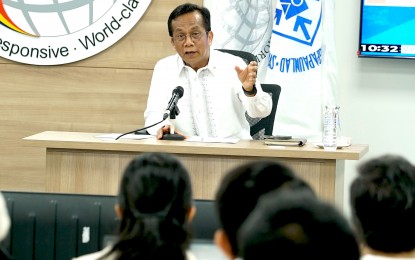

DEPDev Secretary Arsenio Balisacan (PNA photo by Ben Briones)
The government’s 60-day suspension of rice imports starting September 1 is not expected to drive inflation higher, according to Department of Economy, Planning, and Development (DEPDev) Secretary Arsenio Balisacan.
Speaking at a briefing held at the Philippine Statistics Authority (PSA) office in Quezon City on Thursday, Balisacan assured that both the country’s rice inventory and the current global market conditions point to a stable supply.
“Global rice prices have dropped significantly—by over 30 percent from last year’s levels,” Balisacan noted. “Back when we cut the rice tariff from 35 percent to 15 percent, world prices were hovering around USD600 per metric ton. Now, they’re down to USD450–490 per metric ton.”
He explained that with the upcoming local harvest season in September and October, there will be more than enough rice in circulation to meet demand.
“Even with the import suspension, our supply situation remains normal. There is no clear reason to expect any inflationary impact,” Balisacan said.
President Ferdinand Marcos Jr. ordered the two-month import halt to help shield local farmers during the peak harvest period. The move is seen as part of the administration’s broader effort to strike a balance between protecting domestic agriculture and ensuring food security.
Still, Balisacan emphasized the need for constant vigilance.
“Global markets are volatile. Prices can shift quickly due to supply chain disruptions, climate issues, or geopolitical factors,” he said. “That’s why we have to keep a close watch and ensure that our policies can quickly adapt to these developments.”
The government is expected to reassess the situation at the end of the 60-day period.