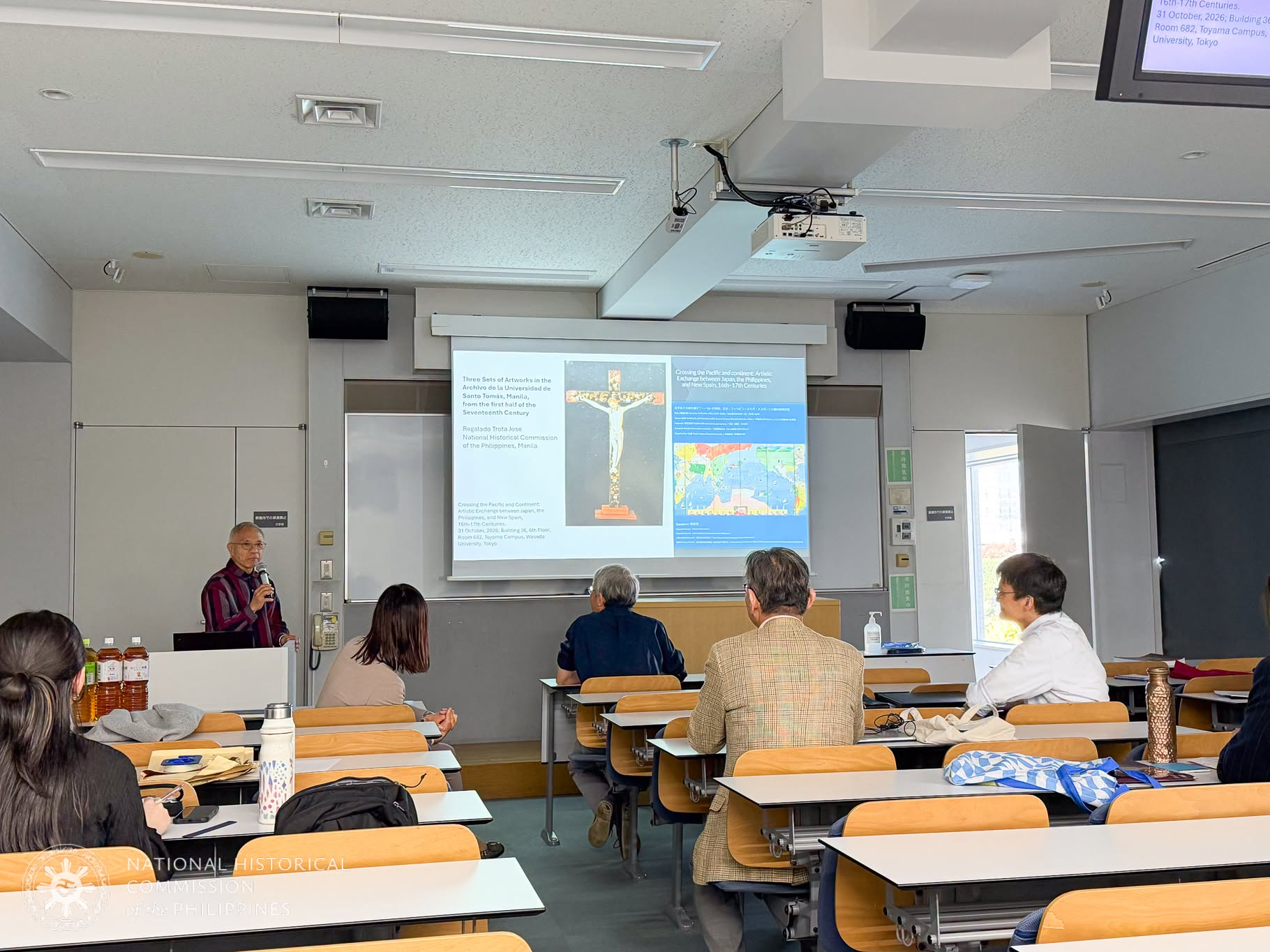

MANILA, Philippines — National Historical Commission of the Philippines (NHCP) Chairperson Regalado Trota Jose Jr. highlighted the country’s historical artistic and cultural connections with Japan and Mexico during an international workshop at Waseda University in Tokyo, Japan, on October 31, 2026.
Jose participated as an invited speaker in the workshop titled “Crossing the Pacific and Continent: Artistic Exchange between Japan, the Philippines, and New Spain, 16th–17th Centuries,” which brought together scholars from Japan, the Philippines, and Europe.
Organized by Waseda University, the gathering examined the movement of religious artworks, cultural objects, and artistic traditions across the Pacific during the 16th and 17th centuries.
Jose delivered a presentation titled “Three Sets of Artworks in the Archivo de la Universidad de Santo Tomás, Manila, from the First Half of the Seventeenth Century,” focusing on historical materials preserved in the University of Santo Tomas (UST) Archives.
His research examined three collections that provide insights into the Philippines’ role in artistic production, religious exchange, and cultural interaction during the Spanish colonial period.
The first collection featured religious prints from a Japanese-language publication printed in Binondo, Manila, in 1623, reflecting historical connections between Japanese religious communities and the Philippines.
The second collection consisted of silver-embellished book and manuscript covers associated with the 17th century, highlighting decorative techniques and artistic craftsmanship during the period.
The third collection included hand-colored engravings from a publication printed in Mexico in 1659, illustrating the movement of religious imagery and artistic influences between New Spain and the Philippines.
Together, the collections provide historical evidence of artistic exchanges linking the Philippines with Japan and territories across the Pacific.
The workshop also featured presentations by Professor Raphaèle Preisinger of the Université de Genève, Dr. Koji Kobayashi of the Tokyo National Research Institute for Cultural Properties, and Dr. Katsura Washizu of the National Museum of Japanese History.
Their participation contributed to scholarly discussions on the circulation of religious art, historical objects, and cultural traditions across different regions.
Jose’s presentation emphasized the importance of Philippine archival collections in understanding the country’s historical relationships with other societies.
The NHCP said his participation also contributed to continuing international scholarly exchanges on Philippine history, art, and cultural heritage.
The research highlighted the significance of preserving historical documents and artworks, particularly those that shed light on the Philippines’ role in regional and trans-Pacific cultural exchanges.
Through international academic collaborations, the NHCP continues to support historical research and promote greater appreciation of the country’s cultural heritage and its connections with the wider world.