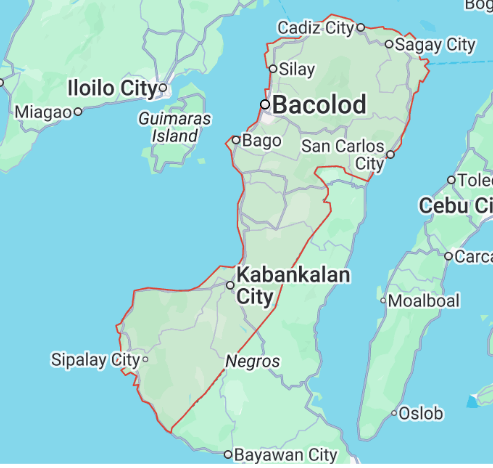

Negros Occidental. Map data by Google Maps.
The Negros Occidental provincial government will implement a compressed four-day workweek starting March 16, in line with energy conservation directives from the Office of the President.
The province recognizes the need to adopt operational measures that align with national energy conservation protocols while maintaining the efficient delivery of public services, Governor Eugenio Jose Lacson said in an executive order issued Saturday.
He cited OP Memorandum Circular 114 dated March 6, 2026, which directs all government agencies, including local government units, to adopt energy-saving measures to cushion the impact of rising global oil prices driven by the ongoing Middle East conflict.
Starting March 16, all Capitol offices in Negros Occidental will operate from 8 a.m. to 7 p.m., Tuesday to Friday, until revoked or modified by the President of the Philippines, Lacson said.
The compressed schedule ensures that the required 40 working hours per week are fully met. Offices providing essential and frontline services will remain fully operational to ensure uninterrupted service. These include provincial hospitals, the Provincial Disaster Risk Reduction and Management Office, and the Economic Enterprise Development Department.
The EEDD manages the Negros Residences, Food Terminal Market, Negros Cyber Center, and Mambukal Resort and Wildlife Sanctuary. Such offices may implement a 10-hour workday with proper shift arrangements to maintain service availability.
All Capitol offices in Negros Occidental are also directed to maximize the use of digital platforms and virtual meetings, limit official travel to essential functions, and use electricity and other energy resources efficiently in line with the national memorandum.
Bacolod City Mayor Greg Gasataya said he will consult department and office heads on the possible implementation of a four-day workweek while continuing energy-saving measures. Administrative offices are instructed to limit air-conditioning use, schedule government vehicle trips properly, avoid unnecessary idling, and ensure that energy-consuming products meet the Philippine Energy Labeling Program standards.