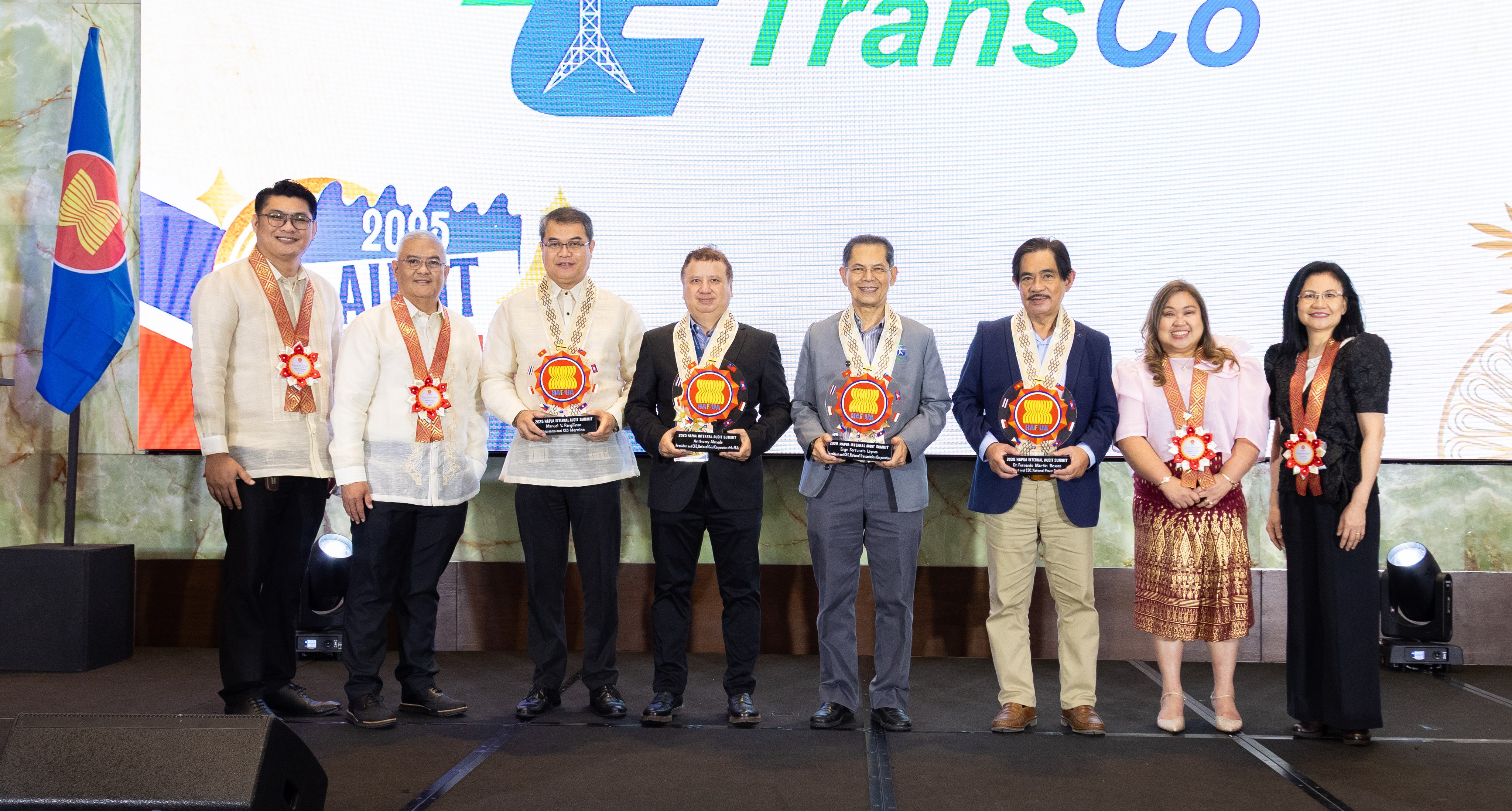

POWERING OPERATIONAL TRANSFORMATION. Manila Electric Company (Meralco) underscored the increasingly important role of internal audit in driving operational transformation in the power sector during the 2025 HAPUA Internal Audit Summit. Seen in photo are (L-R) National Transmission Corporation (TransCo) Internal Audit Department Manager Dexter Comiso, National Grid Corporation of the Philippines (NGCP) Vice President and Chief Audit Executive Edwin Natividad, Meralco Executive Vice President and Chief Operating Officer Ronnie L. Aperocho, NGCP President and Chief Executive Officer Anthony Almeda, TransCo President and Chief Executive Officer Fortunato Leynes, National Power Corporation (NPC) President and Chief Executive Officer Fernando Martin Roxas, Meralco Senior Vice President and Group Chief Audit Executive Melanie T. Oteyza, and NPC Internal Audit Senior Department Manager Vedalisa Arevalo.
The Manila Electric Company (Meralco), led by Manuel V. Pangilinan, highlighted the pivotal role of strategic audit in shaping operational transformation and advancing the future of the Philippine power industry during the 2025 Heads of ASEAN Power Utilities/Authorities (HAPUA) Internal Audit Summit.
In his keynote address, Meralco Executive Vice President and Chief Operating Officer Ronnie L. Aperocho underscored the company’s shift in viewing internal audit not just as a compliance mechanism, but as a proactive driver of risk-aware decision-making and organizational discipline.
“By embedding audit foresight into strategic execution, we ensure that transformation happens with control, not chaos. This is especially vital as we pursue innovation without compromising risk standards or regulatory alignment,” Aperocho said.
The discussion on Meralco’s digital transformation was further expanded by Senior Vice President and Group Chief Audit Executive Melanie T. Oteyza, who presented the company’s approach to auditing advanced metering infrastructure (AMI)—a system she described as the “digital nervous system of modern utilities.”
Meralco’s AMI program plays a central role in enabling customer choice initiatives under government reforms. As of June 2025, the Retail Aggregation Program, powered by AMI, has successfully facilitated the switching of 19 aggregated groups covering 292 services.
Oteyza stressed that auditing AMI requires a new mindset—moving beyond traditional assurance frameworks to a comprehensive assessment of interconnected risks such as cybersecurity, data accuracy, vendor reliability, and regulatory compliance.
She called on ASEAN auditors to embrace insights-driven auditing by harnessing artificial intelligence and analytics to detect anomalies, predict vulnerabilities, and support forward-looking decision-making.
“Internal Audit must evolve from guardians of compliance to catalysts of resilience and innovation. Our role is not only to protect value—but to enable it,” Oteyza emphasized.
Drawing from global best practices, she highlighted the importance of governance in AMI, building resilience through cyber and operational safeguards, and ensuring data assurance. She encouraged ASEAN utilities to adopt these strategies early, stressing that cross-border collaboration and continuous learning are key to building audit maturity across the region.
The HAPUA Internal Audit Summit, held on August 13–14, 2025, brought together 150 delegates from seven Southeast Asian countries, including chief audit executives, industry leaders, and practitioners.
Representing the Philippines at the summit were Meralco, the National Grid Corporation of the Philippines, the National Power Corporation, and the National Transmission Corporation. The annual gathering serves as a platform for knowledge exchange, expert-led discussions, and cooperative efforts aimed at strengthening audit practices across the ASEAN power sector.