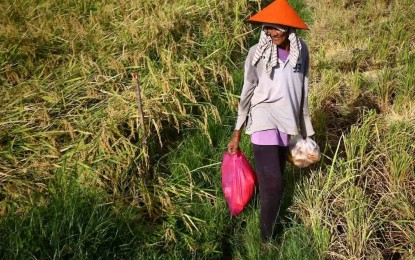

A farmer works in a rice field in Barangay Hubangon, Mahinog, Camiguin in this photo taken on May 1, 2024. To help protect rice farmers amid declining farmgate prices, President Ferdinand R. Marcos Jr. issued Executive Order 100 on Saturday (Oct. 25, 2025), establishing a floor price for palay. (PNA file photo by Joan Bondoc)
President Ferdinand R. Marcos Jr. has signed Executive Order (EO) 100, establishing a floor price for palay (unhusked rice) to shield Filipino farmers from falling farmgate prices and ensure fair compensation amid market volatility.
Under EO 100, the Department of Agriculture (DA) is directed to determine and regularly adjust the government’s palay procurement price based on production costs, market conditions, and reasonable farmer profit margins—while keeping consumer welfare in mind.
The DA will also factor in conditions such as natural disasters, import surges, global price fluctuations, and the government’s purchasing capacity when setting the price.
“The absence of a just and equitable floor price exposes farmers to market shocks, especially during peak harvest seasons when prices tend to crash due to oversupply or unfair trading,” the President said. “This EO guarantees a fair return on investment and supports long-term agricultural sustainability.”
EO 100 creates a steering committee chaired by the DA and co-chaired by the Department of the Interior and Local Government (DILG). Members include the Department of Trade and Industry, Department of Agrarian Reform, Department of Social Welfare and Development, and the National Food Authority (NFA).
The committee will oversee implementation, enforcement, and regular monitoring of palay transactions. It will also submit quarterly reports to the President on the policy’s impact on farmer incomes and rice supply stability.
Violations—such as buying palay below the floor price—will face administrative sanctions.
Temporary storage and post-harvest support
To address storage shortages, the EO authorizes local government units and national agencies to use public facilities such as gymnasiums, covered courts, and multipurpose halls as temporary palay storage sites.
The steering committee will draft strict guidelines for the proper use, maintenance, and security of these facilities to prevent post-harvest losses and maintain grain quality.
Initial funding will come from existing budgets of the involved agencies, with future allocations to be included in their budget proposals, subject to Department of Budget and Management review.
The order takes effect immediately upon publication in the Official Gazette or a newspaper of general circulation.
Addressing farmers’ struggles
Farmer groups have long warned of plummeting farmgate prices, urging the government to set a PHP 5-per-kilo support price and revisit import policies that have depressed local markets. In several provinces, palay prices have dropped to as low as PHP 8 per kilo.
EO 100 responds to these appeals by instituting a nationwide safety net for farmers while maintaining rice affordability for Filipino consumers.
“In the face of climate challenges and rising production costs, this measure reaffirms our commitment to stand by our farmers,” Marcos said. “We cannot allow those who feed our nation to be the ones who go hungry.”