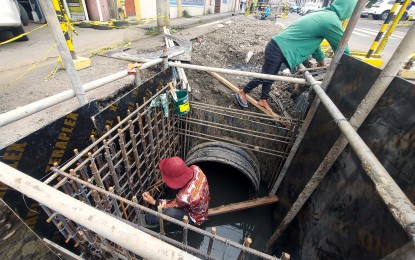

Personnel of the Department of Public Works and Highways work on a drainage project along Legaspi Street in Poblacion District, Davao City on June 13, 2024. At the time, the 20th City Council passed a resolution demanding the DPWH to expedite unfinished road repair and other infrastructure projects. (PNA file photo by Robinson Niñal Jr.)
President Ferdinand R. Marcos Jr. has ordered the Department of Public Works and Highways (DPWH) to slash the cost of construction materials for government infrastructure projects by up to 50 percent — a move aimed at stamping out overpricing and saving billions in public funds.
Marcos made the announcement Saturday during his departure speech at Villamor Air Base in Pasay City, before flying to Kuala Lumpur, Malaysia, for the 47th ASEAN Summit and Related Summits.
The President said a recent DPWH audit revealed alarming discrepancies in the prices of key materials such as asphalt, steel bars, and cement — some marked up by as much as 50 percent.
“Actually, there are some egregious examples where it’s even more than that,” Marcos said. “To ensure that project costs reflect real market prices and that every peso of the people’s money is properly spent, I have directed the DPWH Secretary to bring down the cost of materials by as much as 50 percent. This will result in savings of at least ₱30 to ₱45 billion in capital outlay.”
DPWH Secretary Vince Dizon had earlier outlined his plan to regionalize pricing structures and crack down on inflated project costs — part of a wider reform effort to restore integrity and efficiency in public works spending.
Marcos added that the government will pursue legal action against individuals found involved in anomalous projects and procurement deals.
“At the same time, the Bureau of Internal Revenue will recalibrate its priorities to ensure that all those found complicit in irregularities surrounding flood control and other public works projects are held fully accountable under the law,” he said. “We will uphold fairness in our tax system and transparency in public spending.”
The directive underscores the administration’s push for cleaner governance and greater fiscal discipline — a signal to both the public and private sectors that the era of inflated contracts and unchecked corruption in infrastructure development is coming to an end.