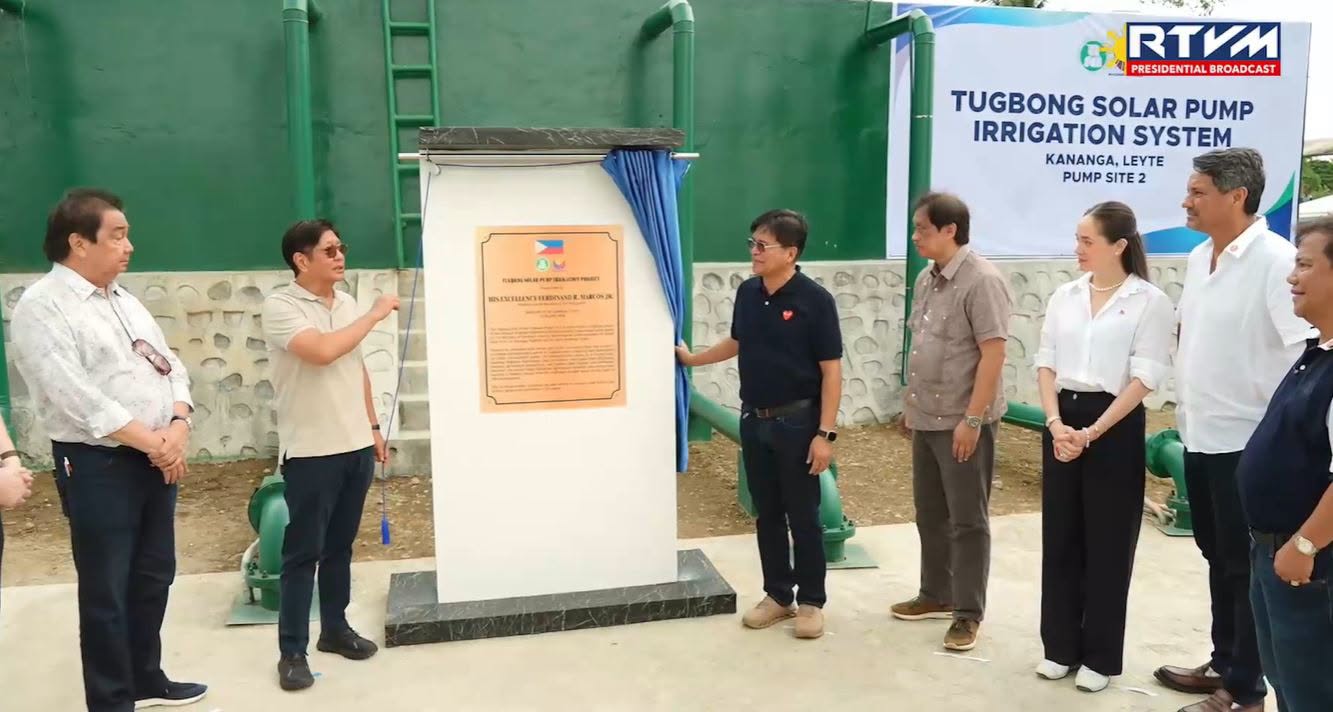

(Photo courtesy of RTVM)
MANILA – President Ferdinand Marcos Jr. inaugurated a solar-powered irrigation facility in Kananga, Leyte, on Friday, October 23, as the government intensifies efforts to improve agricultural production and prepare for a potentially severe El Niño.
During the inauguration of the Tugbong Solar Pump Irrigation Project (SPIP), Marcos emphasized the importance of modern irrigation technology in helping farmers increase their harvests while reducing production costs.
The project, funded by the National Irrigation Administration (NIA), uses solar energy to supply water to 115 hectares of agricultural land across two sites.
Marcos said reliable irrigation could allow farmers to increase their cropping cycles from two to three planting seasons annually.
“Ginagamit nga natin ang mga bagong teknolohiya para naman ay mapaganda ang ating irrigation system sa buong Pilipinas,” the President said.
He stressed that sufficient water supply remains essential to improving agricultural productivity, particularly during prolonged dry periods.
The President also highlighted the financial benefits of solar-powered irrigation, noting that farmers using conventional diesel-powered pumps could spend approximately Php 20,000 per cropping season on fuel.
By harnessing solar energy, farmers could significantly reduce irrigation expenses and allocate more resources to agricultural production.
According to Marcos, the government has already established around 3,000 solar-powered pump irrigation systems nationwide, while approximately 70 percent of the country’s irrigable agricultural lands are now covered by irrigation facilities.
He said expanding irrigation infrastructure has remained a priority of his administration since 2022.
The Department of Agriculture is also distributing smaller solar-powered irrigation pumps to help farmers lower their operating expenses.
With a potentially stronger El Niño approaching, Marcos said the government is accelerating the construction of irrigation systems, water impounding facilities, and other infrastructure to address possible water shortages.
He noted that water levels in major dams are currently higher than those recorded at the beginning of the 2024 drought, providing a more favorable starting point for preparations against prolonged dry conditions.
The administration is also exploring additional uses for water impounding facilities, including fish production and hydropower generation, to maximize their economic benefits.
“Kaya lahat ng paraan na maaari nating gawin ay ginagawa natin upang mapatibay ang sistema ng patubig, ang suplay ng tubig, hindi lamang para sa irigasyon, kung hindi pati na sa ating mga bahay,” Marcos said.
The President assured farmers that the government would continue expanding irrigation services and encouraged them to raise concerns about their agricultural needs.
The Tugbong project forms part of the administration’s broader initiative to strengthen food production, reduce farming costs, and improve water security amid increasing climate-related challenges.