
In a surprising move that signals a clearer break from the previous administration, the Marcos government has stepped up its support for the International Criminal Court (ICC) by offering protection to witnesses set to testify against former president Rodrigo Duterte over his controversial war on drugs.
Justice Secretary Jesus Crispin “Boying” Remulla revealed that the Department of Justice (DOJ) is currently facilitating the protection of individuals preparing to testify before the ICC in The Hague. While Remulla stressed that the government wasn’t actively seeking to assist the ICC, it responded after being approached by the international body’s witness protection personnel.
“We didn’t go out of our way to make this happen,” Remulla admitted. “But when they asked for help to ensure the safety of witnesses, we couldn’t just stand in the way. It’s about ensuring these people can testify freely and safely.”
Remulla confirmed that the Philippine Witness Protection Program is currently sheltering several individuals whose testimonies are seen as critical in the ICC’s case against Duterte, who is facing charges of crimes against humanity. The justice chief emphasized that while he does not personally know the witnesses or ICC staff, he allowed the agency’s internal teams to proceed with the protective measures.

Funding witnesses, not politics
The justice department has agreed to cover the expenses of transporting and safeguarding the witnesses, citing their dire financial situations. “These people don’t have the means to protect themselves or travel,” Remulla said. “So yes, we’re helping them. But only the witnesses—not anyone else.”
This level of cooperation is a marked shift from the government’s previously hesitant stance toward the ICC. Though the Philippines withdrew from the ICC in 2019 under Duterte’s orders, the Marcos administration has shown openness to limited cooperation, especially after Duterte’s recent arrest facilitated through Interpol channels.
Duterte’s detention and victims’ stand
Duterte is currently detained in the Netherlands pending pre-trial proceedings. His legal team has requested interim release on humanitarian grounds, citing alleged health concerns—a request the DOJ deems ill-advised.
“In our view, the Netherlands already provides the best medical care he could access. Releasing him to another country would only complicate things further,” Remulla said, suggesting the court should proceed with the trial swiftly rather than entertain a release.
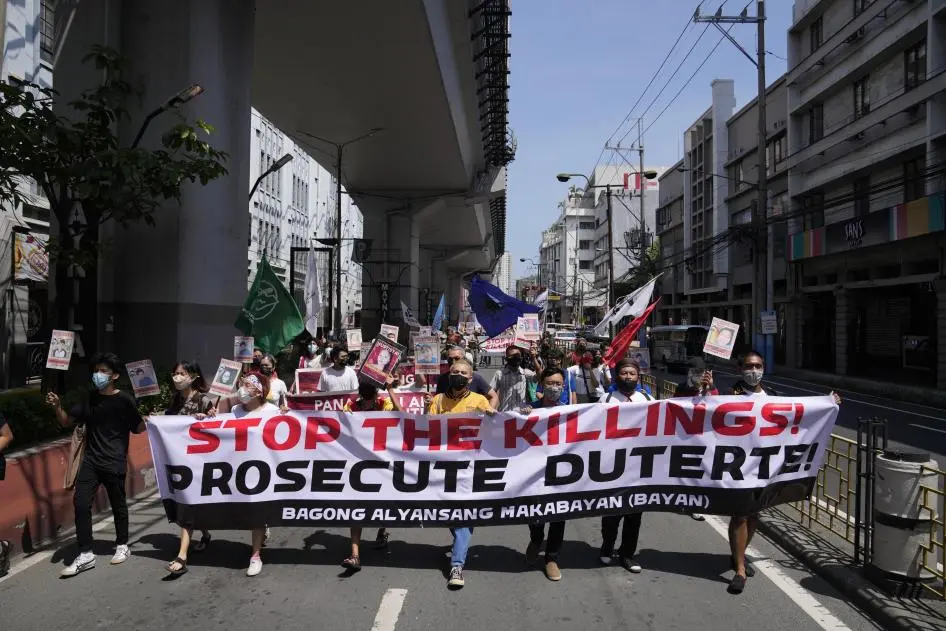
More critically, families of the drug war victims have strongly opposed the move. Represented by the ICC’s Office of Public Counsel for Victims (OPCV), they argue that releasing Duterte—even conditionally—would place them in grave danger and risk obstructing justice.
“Letting him go now could destabilize the fragile security environment, not to mention expose us to direct threats,” read the OPCV’s June 25 filing. “This man still holds considerable power and influence—even from behind bars.”
Still a political force
The victims also highlighted Duterte’s sustained political relevance. Despite his detention, he was recently re-elected as Davao City mayor, and his children—Vice President Sara Duterte and Davao City Vice Mayor Sebastian Duterte—remain in powerful positions.
“These connections increase the likelihood that he could flee or use his influence to interfere with the case,” the OPCV noted.
They also pointed to Duterte’s past antagonistic statements toward the ICC, including his infamous threat of a shootout if ICC agents tried to arrest him in the Philippines—remarks the victims claim reveal a clear intent to obstruct justice.
A shift or strategy?
While the Marcos administration maintains it’s merely complying with a valid request, observers view this as its most explicit act of cooperation with the ICC so far. Whether this signals a full pivot in the Philippines’ international justice stance or a strategic exception remains to be seen.
What’s certain is that the road to justice for the drug war’s thousands of victims has entered a new phase—one in which the Philippine government, once the shield of its former leader, may now play a role in holding him accountable.