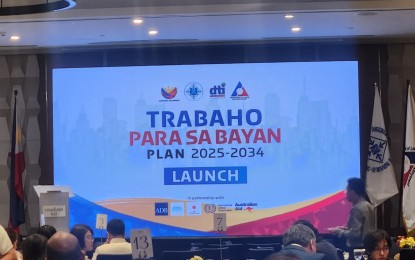

The Department of Economy, Planning, and Development (DEPDev), Department of Trade and Industry (DTI), and Department of Labor and Employment (DOLE) launch the Trabaho Para sa Bayan (TPB) Plan 2025 at Citadines Bay City Manila in Pasay City on Monday (May 5, 2025). The TPB Plan is the country’s first long-term comprehensive national employment plan. (PNA photo by Kris M. Crismundo)
The Marcos administration has introduced a comprehensive 10-year strategy aimed at creating high-quality jobs, enhancing the skills of the Filipino workforce, and preparing the country’s labor market for future challenges.
Launched in Pasay City, the Trabaho Para sa Bayan (TPB) Plan 2025–2034 was jointly presented by the Department of Economy, Planning, and Development (DEPDev), the Department of Trade and Industry (DTI), and the Department of Labor and Employment (DOLE). It is the Philippines’ first long-term national employment blueprint, fulfilling the mandate of Republic Act 11962, or the Trabaho Para sa Bayan Act.
The TPB Plan aims to raise the country’s labor force participation rate to 68.2% by 2034. In 2023, the Philippines recorded a rate of just 64.9%—the lowest among ASEAN peers. By comparison, Malaysia led the region at 70%, followed by Indonesia (69.5%), Vietnam (68.9%), and both Singapore and Thailand at 68.6%.
The plan also targets a reduction in unemployment to 3% and seeks to lower underemployment to between 7% and 9%. This marks a notable improvement from the 2023 figures, which stood at 3.8% unemployment and 13.3% underemployment.
DEPDev Undersecretary Rosemarie Edillon outlined the government’s key strategies to meet these targets. These include encouraging more investments to spur job creation, improving the ease of doing business, promoting technology adoption, strengthening school-to-work transition programs, expanding social protection, and boosting participation in skills training programs—especially among priority sectors.
“This transformation strengthens our mandate as we integrate various socioeconomic goals into a unified and forward-looking strategy that truly benefits all Filipinos,” said DEPDev Secretary Arsenio Balisacan during the launch.
He emphasized the need for adaptive and inclusive policies that support workers amid rapidly evolving economic and technological landscapes. “With our collective effort, we will create an inclusive, efficient, and dynamic labor market environment where Filipinos can access meaningful, quality jobs—enabling them to live a matatag, maginhawa, at panatag na buhay,” he added.
Embracing artificial intelligence
A major component of the TPB Plan is the acceleration of technological adoption, particularly artificial intelligence (AI). Edillon highlighted how AI can significantly boost workforce productivity if properly harnessed.
World Bank lead economist Gonzalo Varela, also present at the event, noted that 35% to 37% of jobs in the Philippines could be impacted by generative AI. Of these, roughly half may be enhanced by the technology, while the other half risks displacement.
Varela stressed the urgent need for upskilling and workforce development to ensure Filipinos can adapt to and thrive alongside emerging technologies.