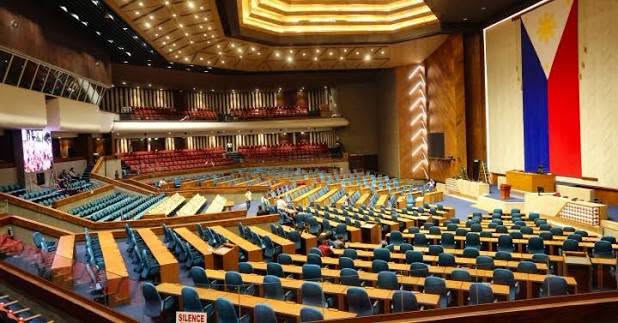

(Photo courtesy of House of Representatives)
MANILA — Major political parties in the House of Representatives on Monday, November 9, expressed support for the full public disclosure of congressional district allocations under the proposed 2027 national budget amid growing scrutiny of budget amendments and alleged irregularities in infrastructure spending.
Representatives of the National Unity Party (NUP), Nationalist People’s Coalition (NPC), Lakas-Christian Muslim Democrats (CMD), Partido Federal ng Pilipinas (PFP) and Nacionalista Party (NP) said lawmakers should be prepared to explain how public funds are allocated and which projects they are intended to finance.
During a press conference, Camarines Sur 4th District Rep. Arnie Fuentebella said the NPC supports making information on district projects and funding allocations accessible to the public.
“Wala po kaming problema na ipakita kung ano ‘yung mga proyekto sa kanya-kanyang distrito,” Fuentebella said.
“We want to be very transparent. And makikita naman po talaga ito,” he added.
Negros Oriental 3rd District Rep. Janice Degamo said Lakas members were likewise willing to disclose their respective budget allocations.
“Every member of the party is open to show the budget,” Degamo said. “Walang tinatago po ang mga kasama natin in the party.”
Davao del Norte 2nd District Rep. JM Lagdameo said the PFP shared the position of the other political parties, particularly on providing public access to budget information through the House’s online portal.
“On behalf of PFP, we share the same sentiment as Honorable Fuentebella and Honorable Degamo for the point of transparency for our budget and the budget process,” Lagdameo said.
“We’re okay to have it open as well as the portal being available also as a method of or a means of transparency,” he added.
Surigao del Sur 1st District Rep. Romeo Momo Sr. said the Nacionalista Party also supports the disclosure of district allocations.
However, Momo clarified that transparency should not be interpreted as requiring equal funding for every congressional district.
He explained that allocations vary depending on population, geographical conditions, infrastructure requirements and exposure to natural disasters.
“We believe that there is no equal allocation in each district. Wala hong equal talaga,” Momo said.
He noted that larger districts and areas frequently affected by typhoons, earthquakes and flooding may require additional infrastructure funding.
Meanwhile, Bataan 2nd District Rep. Albert Garcia of the NUP cited reforms introduced by the House to improve public access to budget documents and legislative deliberations.
FPJ Panday Bayanihan party-list Rep. Brian Poe also expressed support for transparency but explained that party-list representatives operate differently from district lawmakers.
Poe said party-list groups submit funding requests to government agencies based on the needs of the sectors they represent, including health, agriculture and education.
“So, unlike a district where you have a set budget for a district, it’s more of requests that are submitted to agencies from party-lists for their sectors or the groups they represent,” he said.
House cites budget reforms
Garcia, senior vice chair of the House Committee on Appropriations, said the chamber had implemented significant changes to the budget process following controversies involving alleged ghost infrastructure projects and questionable government spending.
Under the leadership of Speaker Faustino Dy III and House Majority Leader Ferdinand Alexander Marcos, the House has opened budget hearings to the public, expanded private sector participation and established an online portal for budget documents.
“Let us acknowledge the fact that we have made earth-shaking reforms with regards to the budget,” Garcia said.
He said the House also replaced the controversial small committee with a new mechanism for reviewing proposed budget amendments.
“These are new reforms that have never happened before. And we’re learning as we go along,” he added.
Garcia recalled that civil society organizations requested an online budget portal during a September 8 consultation.
According to the lawmaker, the House established the portal the following day to improve public access to budget information.
He also reiterated Dy’s commitment to preventing questionable infrastructure projects from being included in the national spending plan.
“With regards to the ghost project, the Speaker said, ‘Not on my watch,’” Garcia said.
Despite the changes, Garcia acknowledged that further improvements were necessary to strengthen transparency and accountability.
“Are we happy with the reforms? Are we complete with the reforms? Is it perfect already? No. Far from it,” he said.
“We welcome the critique of the media and our civil society, the Church. And we try to improve as we go along.”
The proposed Php 7.2-trillion national budget for 2027, approved by the House of Representatives, is currently under Senate review before the two chambers convene for bicameral deliberations.
The lawmakers’ statements come amid continuing public demands for greater scrutiny of congressional budget amendments, particularly infrastructure allocations and the identification of projects funded through the national budget.