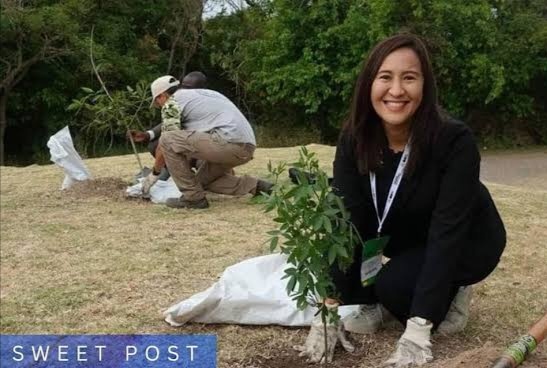

Quezon City mayor ‘Joy’ Belmont launched the Luntiang Kyusi: One Million Trees Initiative to support the government’s efforts for environment conservation. (Photo from Facebook)
Four local communities have been given recognition by the Association of Southeast Asian Nations (ASEAN)’s Green Initiative (AGI) for their success in conservation work resulting from their empowerment and engaging their members in environmental initiatives.
AGI, as described by the ASEAN Center for Biodiversity (ACB) executive director Jerome Montemayor, highlights people-driven ecosystem restoration practices across Southeast Asia, especially in grassroots communities that are addressing biodiversity loss, land degradation and ecosystem collapse.
“It is also aims to grow 10 million native trees in the region over 10 years. The recognition given to representatives of the four Philippine awardees took place during the ASEAN Heritage Parks Forum,” Montemayor disclosed.
In Purok Santol in Barangay Banlag, Monkayo, Davao de Oro, a young forest is taking root through the Philippine Eagle Foundation’s (PEF) Mongkayo Pag-asa Carbon Forest (MPCF) project. Since 2022, more than 22,800 native trees have been planted and cared for by the Banlag Santol Kinaiyahan Workers Association.
The MPCF is a partnership with the local government of Davao de Oro, Department of Environment and Natural Resources (DENR) and the Yap family who donated the 22.4-hectare project site.
Meanwhile, in Mangatarem, Pangasinan, forester Celso Salazar is leading the Pangasinan Native Tree Enthusiasts in restoring 20 hectares of public land where about 9,000 native trees have been planted to create the Daang Kalikasang Native Trees Arboretum and Ecological Restoration Initiative. Salazar noted that the project aims to “turn the barren hills into a massive, living library of trees” where people can learn about Philippine native trees.
According to Salazar, the project is a nature-based solution that will mitigate the impact of climate change: “We wanted to use nature to heal nature, so we focused on bringing back indigenous, native trees. We are not just planting green cover. We are anchoring the soil to withstand typhoons.”
In Baragay San Teodoro in Bunawan, Agusan del Sur, artist and cultural worker Grace Nono has turned inherited family land into the Alima Eco, Agri and Heritage Park, restoring degraded peatlands while raising awareness of an ecosystem that has been historically viewed as undesirable.
Combining indigenous knowledge and practice with modern scientific methods, Nono is currently working with indigenous conservationists and soil scientists to bring her peatland back to its natural balance through integration and the planting of native trees and gardens of indigenous crops and medicines while also serving as the home of the Agusanon-Manobo School of Living Traditions, which has been based on Nono family land since 2017.
Finally, with 600,000 trees planted, Quezon City’s Luntiang Kyusi: One Million Trees Initiative is more than halfway toward its target in 2030.
According to Quezon City mayor Maria Josefina Tanya ‘Joy’ Belmonte, the project supports a planned green corridor network and implementation of an urban biodiversity strategy: “We prioritize native species suited to our local soil and climate, including edible and fruit-bearing trees for urban food security. We also make sure that our restoration efforts do not introduce new ecological threats.”