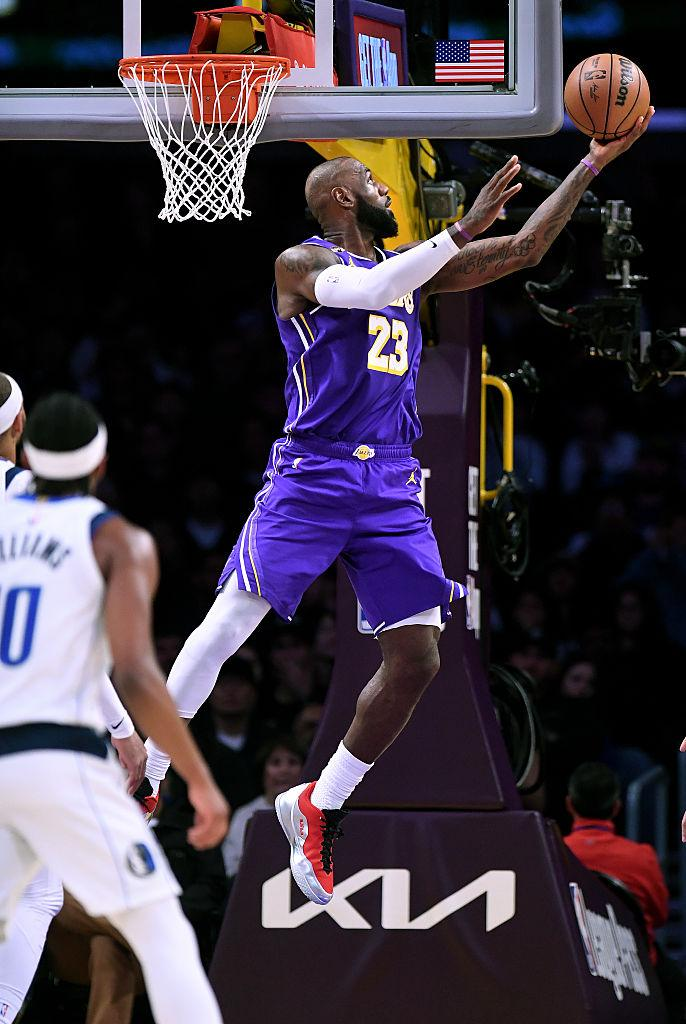

At an age when most NBA legends are long retired or relegated to ceremonial roles, LeBron James is still dictating the tempo of meaningful games — and rewriting history in the process.
The 41-year-old superstar delivered 28 points, 12 assists, and 10 rebounds to power the Los Angeles Lakers to a commanding 124-104 victory over the Dallas Mavericks on Thursday night in Los Angeles. The final rebound, secured with just over two minutes left, sealed not just another win — but a record.
At 41 years and 44 days old, James became the oldest player in NBA history to register a triple-double, surpassing the mark previously held by Karl Malone, who achieved the feat at 40 years and 127 days during his final season in 2003.
When James checked out moments later, the arena rose in appreciation. It was his 123rd career triple-double in the regular season — fifth-most all-time — and a reminder that his longevity is no longer just impressive; it is unprecedented.
This was not a ceremonial performance padded in garbage time. James controlled the contest from the opening quarter, pouring in 14 points and six assists in the first 12 minutes alone. By halftime, he was already flirting with the milestone.
With Luka Doncic sidelined by a mild hamstring strain, the Lakers leaned heavily on their veteran cornerstone. James responded by playing the entire fourth quarter, orchestrating possessions, finding open shooters, and attacking the rim with calculated aggression.

What makes the performance remarkable is not merely the stat line — it is the context. James has battled injuries this season, missing significant time with sciatica and other ailments. He has also logged 22 All-Star selections, a record that speaks to durability and dominance across eras.
And yet, even with 152 career triple-doubles when playoff games are included, this latest achievement felt symbolic. It arrived just before the All-Star break — a checkpoint in a season where many wondered how much he still had left.
James entered the night averaging 21.8 points, 6.9 assists, and 5.7 rebounds — numbers that would be celebrated for a player in his prime. For a 41-year-old in his 23rd season, they border on absurd.
The Lakers remain entrenched in a tight Western Conference playoff race, having rarely enjoyed a fully healthy rotation of James, Doncic, and Austin Reaves together. Yet even amid roster instability and injury setbacks, James continues to be the franchise’s stabilizing force.
The record itself may eventually fall. But what is increasingly clear is that James has transformed the definition of aging in professional basketball. He is no longer just chasing championships or adding accolades — he is stretching the limits of what an NBA career can look like in its third decade.
On a night that began as another regular-season matchup, the King quietly expanded his legacy once more — not with nostalgia, but with production.
And at 41, he is still not done.