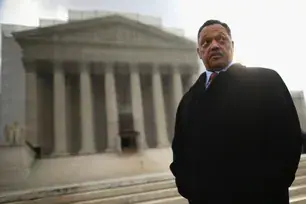

WASHINGTON — The Rev. Jesse Jackson, a towering figure in America’s civil rights movement whose presidential bids in the 1980s broadened the political horizon for African Americans, dies Tuesday at 84, his family announces.
In a statement, relatives honor his lifelong fight for justice, equality and compassion, saying his voice inspired generations across racial and social lines. For more than six decades, Jackson occupies a singular space at the intersection of protest, pulpit and politics.
A protégé of Martin Luther King Jr., Jackson rises to prominence in the 1960s through the Southern Christian Leadership Conference, emerging as one of the movement’s most recognizable young leaders. He is in Memphis in 1968 when King is assassinated, a moment that sears his commitment to racial justice.
Jackson later founds Operation PUSH in 1971 and the National Rainbow Coalition in 1984, organizations that press for economic opportunity, voter mobilization and minority representation before merging in the mid-1990s. His activism stretches beyond US borders, as he mediates in international disputes and advocates for sanctions against apartheid-era South Africa.
His two runs for the Democratic presidential nomination redefine what is politically possible for Black candidates. In 1984, he places third behind Walter Mondale and Gary Hart, the strongest showing by an African American contender at the time. Four years later, he finishes second to Michael Dukakis and delivers a convention speech urging Americans to seek “common ground,” declaring that “it takes two wings to fly.”
Though he never captures the nomination, Jackson’s campaigns embed issues such as jobs expansion, drug policy reform and minority rights into the Democratic Party’s core agenda. Many credit his groundwork with helping pave the way for the election of Barack Obama in 2008, a victory Jackson witnesses in tears on election night.
Born Jesse Louis Burns on Oct. 8, 1941, in Greenville, South Carolina, to a teenage mother, he later takes the surname of his stepfather. A standout student and athlete, he attends the University of Illinois on a football scholarship before completing a sociology degree at North Carolina Agricultural and Technical College. He joins sit-ins and marches in the early 1960s, including the Selma-to-Montgomery campaign that captures national attention.
Jackson’s career, while pioneering, is not without controversy. A 1984 remark referring to New York as “Hymietown” draws backlash and apology. One of his sons, former congressman Jesse Jackson Jr., later serves prison time for misusing campaign funds. In 2017, Jackson discloses that he has Parkinson’s disease, gradually stepping back from public life but continuing to appear at pivotal moments, including alongside the family of George Floyd after the 2021 murder conviction of a former police officer.
Until his final years, Jackson frames the quest for racial equality as unfinished work. Progress, he says repeatedly, may bring relief, but never signals the end of struggle.