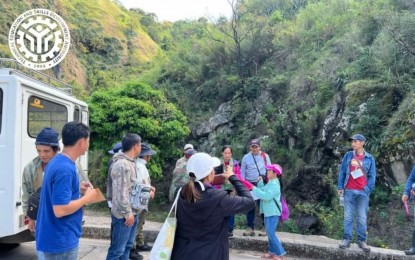

Technical Education and Skills Development Authority-Cordillera provides tour guide training in Besao, Mountain Province in November 2024. Growth in the Cordillera Administrative Region’s economy is partly due to the services and tourism sectors. (Photo courtesy of TESDA-Cordillera Facebook)
BAGUIO CITY – Inter-agency efforts to invest in human capital helped sustain growth in the Cordillera Administrative Region (CAR).
Based on October 2024 data of the Philippine Statistics Authority-CAR, the region’s employment rate stood at 97.7 percent, higher than the national average of 96.1 percent. Services were the top employment generators.
Department of Tourism-Cordillera director Jovita Ganongan said tourism accounts for a significant share of employment figures.
“With the high demand for human resources in the industry, we continue to assist stakeholders in upskilling and reskilling their personnel. We need to level up not just in terms of services provided but also in the workers’ skills so that they can have more chances as the industry grows,” she said.
Ganongan said the pandemic did not stop the industry from expanding, as stakeholders used it to upgrade facilities and train workers on the “Filipino Brand of Service.”
She said over 20,000 workers received training in 2024 to help improve products and services.
“Tourism creates livelihood activities that generate jobs formally and informally,” she said.
Ganongan clarified that the training was not limited to those working in hotels and restaurants but also included taxi drivers, senior citizens intending to work as tour guides and police officers.
“We need to know how to handle and assist the tourists so that they get a good experience in Baguio and the whole region,” she added.
The Technical Education and Skills Development Authority (TESDA) also joined the bandwagon by providing more scholarships on tourism-related skills using its P500 million allocation for CAR.
The training included food and beverage skills, bed-making, cookery, baking, housekeeping, front desk operation and services, organic agriculture production, coffee production, agro-entrepreneurship, and weaving.
The agency reported earlier that more than 66,000 individuals from all six provinces and two cities of the region—Abra, Apayao, Benguet, Ifugao, Kalinga, Mountain Province, Tabuk, and Baguio—availed of scholarships.
TESDA-CAR reported that as of Nov. 30, 2024, it had registered a 91.94 percent certification rate of scholars.
The region has a population of about 1.3 million people of working age, of which around 64 percent are in the labor force.
Ganongan said Baguio City remained to have the largest share in tourist arrivals but pointed out that it continues to promote other areas that offer different attractions, such as culture and the arts, nature, and gastronomy.
The average weekly arrivals are between 20,000 and 30,000, with more than 70 percent during weekends. They can double to 60,000 during peak seasons like the Holy Week and Christmas. (PNA)