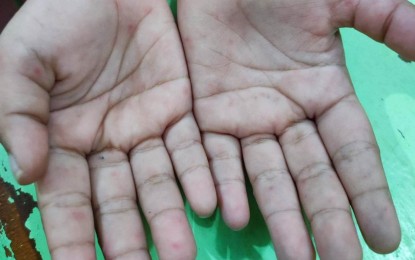

The Iloilo Provincial Health Office on Friday (Aug. 15, 2025) reports an increasing number of hand, foot and mouth disease (HFMD) cases from January to Aug. 9 this year. It urges children to frequently wash their hands avoid borrowing other people’s personal belongings. (PNA file photo by Perla Lena)
ILOILO CITY – Iloilo logged a 382-percent increase in hand, foot and mouth disease (HFMD) cases with 1,685 from January to Aug. 9 this year, compared with 349 cases for the same period in 2024.
In an interview on Friday, Iloilo Provincial Health Office health service delivery division head Dr. Rodney Labis said for the latest monitoring week, the province recorded 156 new cases.
According to the report of the provincial epidemiology and surveillance unit, the highest cases came from Passi City. For the mentioned period, Passi has 160 cases compared with only seven cases in the same period last year, or an increase of 2,186 percent.
Other municipalities included in the list with high cases are Lambunao with 99; Barotac Nuevo, 95; Tigbauan, 88; Carles, 78; Concepcion, 75; Barotac Viejo, 66; Lemery, 64; Leon, 61; and Miagao, 57.
“Our data showed that the highest number of hand, foot and mouth disease cases are in children one to five years old. Most of our cases are mild, although a few cases were admitted to hospitals,” he said.
Labis said the HFMD is caused by a virus and mostly affects children.
The symptoms include rashes on legs, arms, soles of feet, buttocks and palms of hands; fever and sore throat.
Without appropriate medical intervention, the rashes can lead to bacterial infection, needing additional treatment.
He recommended that children with symptoms be brought to the nearest health center or trusted health provider.
The medical officer advised children not to report to school and to avoid going to public places to prevent the spread of the disease.
To avoid the virus, frequent hand washing is encouraged.
Children are also encouraged to refrain from borrowing other people’s personal things such as toys, pens, cellphones, and handkerchiefs, among others; and refrain from touching their nose, eyes and mouth. (PNA)