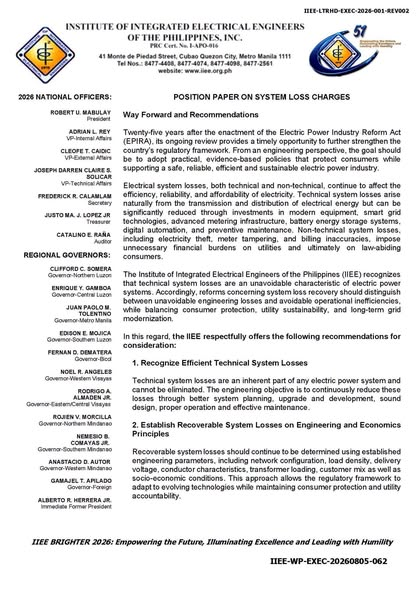

MANILA, Philippines — The Institute of Integrated Electrical Engineers of the Philippines (IIEE) has urged policymakers to ground proposed reforms on system loss charges in sound engineering principles, warning that overly simplistic measures could undermine the reliability and long-term sustainability of the country’s power sector.
In a position paper released Wednesday, the IIEE said the ongoing review of the Electric Power Industry Reform Act offers an opportunity to improve consumer protection while accelerating the modernization of the Philippine electricity network.
The organization called on policymakers to adopt “practical, evidence-based policies” that would shield consumers from unnecessary costs without compromising the safety, efficiency, and reliability of power services.
At the heart of the issue, the IIEE said, is the need to clearly distinguish unavoidable technical losses from operational inefficiencies that utilities can prevent or reduce.
“Technical system losses are an inherent part of any electric power system and cannot be eliminated,” the group said.
Electricity naturally dissipates as heat while traveling through transmission lines, distribution networks, transformers, and other equipment. According to the IIEE, the proper engineering objective is not to promise the complete elimination of these losses, but to continuously reduce them through better planning, improved system design, infrastructure upgrades, efficient operations, and proper maintenance.
The group stressed that technical losses should not be treated in the same manner as non-technical losses, which may arise from electricity theft, meter tampering, inaccurate billing, and other operational problems.
Such avoidable losses, it said, create unnecessary financial burdens on power utilities and, ultimately, on law-abiding consumers.
The IIEE therefore called for a system loss recovery framework that separately evaluates unavoidable engineering losses and preventable inefficiencies while balancing consumer welfare, utility viability, and the need for sustained investments in the power grid.
It said allowable or recoverable system losses should continue to be assessed using established engineering and economic standards rather than through a uniform policy that fails to account for differences among distribution networks.
Among the factors that regulators should consider are network configuration, customer and load density, delivery voltage, conductor specifications, transformer loading, customer mix, and prevailing socioeconomic conditions.
“Recoverable system losses should continue to be determined using established engineering parameters,” the IIEE said.
The organization also urged regulators to strengthen accountability by adopting performance-based engineering regulation.
Under such an approach, utilities would be required to meet measurable technical and operational targets while being encouraged to improve efficiency and service reliability.
“Recovery mechanisms should continue to encourage utilities to improve technical performance while ensuring accountability through measurable engineering and operational performance indicators,” the group said.
To further reduce losses and strengthen the power network, the IIEE pushed for continued investments in distribution automation, advanced metering infrastructure, smart grid systems, voltage optimization, and other modern engineering solutions.
The group, however, cautioned that reforms must be implemented equitably, particularly for financially constrained electric cooperatives and distribution utilities that may lack the resources needed to immediately upgrade their networks.
It recommended that any changes to system loss recovery be accompanied by financing support, technical assistance, and performance-based investment programs that would enable smaller utilities to modernize without disrupting electricity service.
“Any reform affecting system loss recovery should be accompanied by mechanisms that will enable financially constrained distribution utilities to modernize their networks,” the IIEE said.
The organization also expressed its readiness to assist Congress, the Department of Energy, the Energy Regulatory Commission, the National Electrification Administration, and other stakeholders in crafting technically sound reforms.
The IIEE said engineering-based policies would allow the government to protect consumers from avoidable costs while ensuring that power utilities remain capable of investing in safer, more efficient, and more reliable electricity networks.