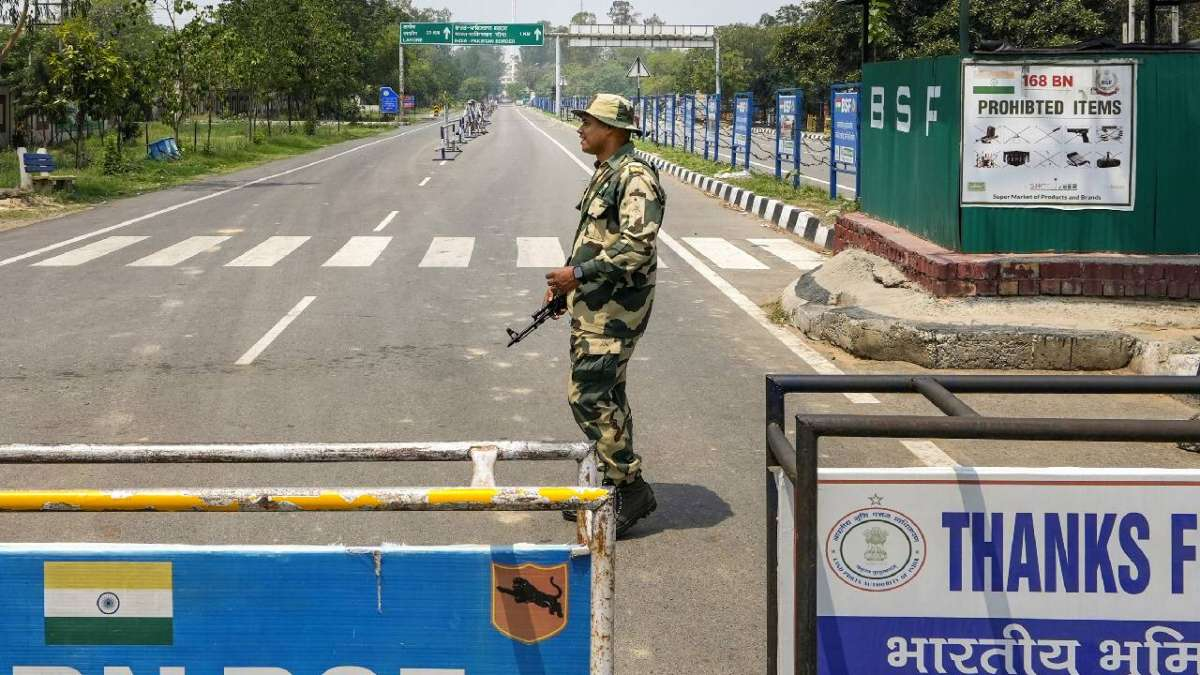

In a tense week marked by cross-border skirmishes and soaring rhetoric between India and Pakistan, a small circle of senior U.S. officials quietly executed a high-stakes diplomatic maneuver—one that may have averted a full-blown conflict between the two nuclear-armed nations.
While President Donald Trump remained publicly silent for most of the week, Vice President JD Vance, acting National Security Adviser Marco Rubio, and White House Chief of Staff Susie Wiles orchestrated a discreet but intensive effort to pull both sides back from the brink. According to multiple administration sources, the turning point came early Friday morning, when classified intelligence signaled an imminent escalation that could spiral out of control.
The nature of the intelligence remains closely guarded, but officials say it was serious enough to galvanize action. Within hours, Vance was on the phone with Indian Prime Minister Narendra Modi, urging direct dialogue with Pakistan and proposing a face-saving “off-ramp” to help both sides step back from confrontation.
Notably, this intervention came just 24 hours after Vance had publicly dismissed the conflict as outside America’s purview, telling Fox News, “We’re not going to get involved in the middle of a war that’s fundamentally none of our business.” That public posture masked what was, in reality, a flurry of backchannel diplomacy unfolding behind closed doors.
Rubio, who had begun preliminary outreach to South Asian counterparts earlier in the week, ramped up those efforts following Vance’s call. Working late into the night, State Department officials communicated with Indian and Pakistani diplomats, trying to bridge a critical communications gap that had developed between the two rivals.
“There was a genuine concern that both sides were operating in the dark and dangerously miscalculating each other’s intentions,” one official involved in the outreach said. “Our role wasn’t to dictate terms but to get them talking again.”
Though Washington did not help draft the final ceasefire agreement, U.S. officials believe their efforts were instrumental in restarting dialogue. Vance’s personal rapport with Modi—built during a recent visit to New Delhi—was seen as a pivotal asset in gaining India’s attention at a delicate moment.
The ceasefire, announced Saturday morning after a day of intense fighting in Kashmir, was hailed as a breakthrough by the Trump administration. President Trump took to social media to proclaim a “full and immediate ceasefire,” followed closely by Rubio, who confirmed that India and Pakistan had agreed to engage in broader talks at a neutral location.
Still, the public responses from New Delhi and Islamabad reflected their long-standing differences in how they view international involvement. Pakistan, which has historically welcomed U.S. mediation, was quick to offer gratitude. “We thank President Trump for his leadership and proactive role for peace in the region,” Pakistani Prime Minister Shehbaz Sharif posted on social media.
India, however, offered no such acknowledgment. Its foreign secretary made no mention of American assistance, instead characterizing the deal as a bilateral achievement. This divergence is emblematic of the two nations’ broader geopolitical instincts: India, wary of appearing reliant on foreign powers, is known for rejecting external mediation; Pakistan, by contrast, often seeks support from global actors.
State Department spokesperson Tammy Bruce downplayed the asymmetry in reactions, highlighting the success of the U.S. diplomatic approach. “This wasn’t about the spotlight. It was about impact,” she said. “The insight and vision of President Trump, executed so deftly by Vance and Rubio, made this moment possible.”
The road ahead remains uncertain. Shelling was still reported in Kashmir hours after the ceasefire was announced, raising questions about the agreement’s durability. But for now, the guns have largely fallen silent—and U.S. officials are hoping that silence holds.
What’s clear is that behind Vance’s tough public stance lay a quietly evolving strategy—one that blended caution with calibrated intervention. It’s a glimpse into how the Trump administration may be reimagining America’s role in global conflicts: less as an overt mediator, more as a behind-the-scenes facilitator when the stakes demand it.