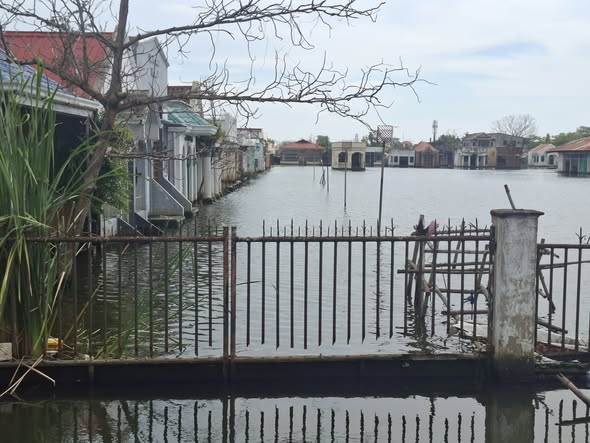

In Hagonoy, Bulacan, Undas has become an annual ritual not just of remembrance, but of resilience. Nearly four months after Typhoon Crising swept across Central Luzon, the town remains waterlogged—a reflection of the deeper crisis haunting its people: years of unfinished, defective, and allegedly ghost flood-control projects that have failed to keep the tides at bay.
The floods have never truly left Hagonoy. Caught between the Pampanga River delta and Manila Bay, the town’s low-lying terrain has made it one of Bulacan’s perennial water basins. When heavy rains come and dams release water upstream, the streets turn into rivers and the cemeteries into shallow lakes.
Yet, even knee-deep floods could not dampen the devotion of residents this Undas. Families arrived in the early morning, clutching candles and flowers, wading through murky water that covered the tombs of their loved ones.
Among them was 39-year-old Bernadeth Javier from Barangay Tampok, who carried a broom and bouquet as she carefully made her way across the submerged path to the graves of her brother and grandmother.

“I wanted to come early to clean their graves,” she said, water rippling around her knees. “This is the only time I can visit them in a year. I just hope the government finally fixes this place—fill it up, drain it, do something—so people can visit their dead without walking through floodwater.”
For others like Mark Nelson Umali of Barangay San Sebastian, the annual visit was both an act of faith and frustration. With his cousins, he scrubbed moss off the concrete tombs of his grandparents and cousin, all while standing in stagnant water.
“We clean the graves because it’s slippery,” Umali explained. “Our elderly relatives could fall and get hurt. We do this for our loved ones, even if the floods make it so hard to visit them.”
Then, with a weary smile, he added, “My feet are always soaked—I’ve got infections already. It’s not just water anymore. It’s neglect. The flood here is getting worse, and we feel forgotten.”
Their words echo the growing anger among locals who say that several flood-control projects, supposedly completed years ago, either do not work or exist only on paper. These “ghost projects,” as residents now call them, have become symbols of betrayal—structures built not to protect the people, but to profit a few.
Now, as candles float beside half-submerged graves, Hagonoy’s residents pray for more than just the souls of their departed. They pray for justice—for clean water, for working pumps, for honest governance.
Because here, in this drowned town by the bay, remembrance and resistance have become one and the same.

