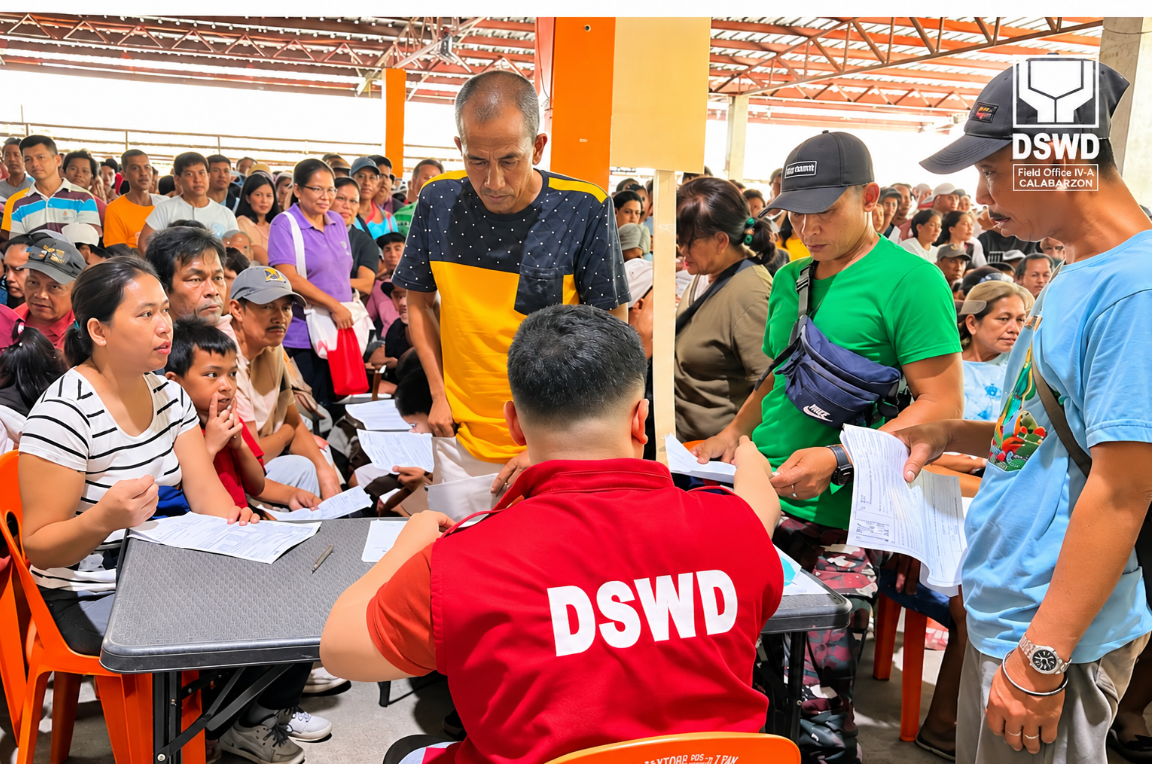

(Photo courtesy of DSWD Region 4-A’s Facebook page)
The government is stepping up efforts to improve agricultural production, strengthen food distribution and provide financial assistance to sectors affected by rising fuel and energy costs as inflation climbed to 7.8 percent in October.
The Department of Economy, Planning, and Development (DEPDev) said Thursday that targeted interventions are being implemented to ease price pressures and protect consumers, particularly vulnerable households and workers.
The Philippine Statistics Authority (PSA) reported that headline inflation accelerated to 7.8 percent in October from 7.2 percent in September, driven largely by higher transportation and energy expenses.
Transport inflation surged to 20.1 percent from 14.6 percent, while inflation for housing, water, electricity, gas and other fuels increased to 9.3 percent from 8.4 percent.
Food inflation, however, eased to 6.4 percent from 6.8 percent in September, supported by favorable weather conditions and improved agricultural supply.
The slowdown was attributed mainly to slower price increases in fish, vegetables, tubers, plantains, cooking bananas and pulses.
To sustain food production and stabilize supply, DEPDev said the Department of Agriculture (DA) has expanded assistance under the Rice Competitiveness Enhancement Fund (RCEF).
The program provides farmers with certified seeds, agricultural machinery, training and credit support to increase productivity and strengthen domestic rice production.
The DA is also expanding KADIWA ng Pangulo outlets and direct marketing programs to connect farmers directly with consumers and help make essential food products more affordable.
As of October 21, the agriculture department had released Php 11 billion in production support, indemnification payments, cash assistance and other interventions for affected farmers and fisherfolk.
Meanwhile, the government began distributing Php 3 billion in fuel subsidies in October to approximately 300,000 farmers, fisherfolk and agricultural delivery-truck drivers.
Under the program, qualified farmers and fisherfolk will receive a one-time Php 5,000 subsidy, while delivery-truck drivers will get Php 2,000 weekly to help cover transportation costs for agricultural products.
The Department of Energy (DOE) is also implementing measures to maintain sufficient electricity supply amid El Niño conditions, including increasing generation capacity and accelerating the deployment of energy storage systems.
The Energy Regulatory Commission (ERC), in coordination with the DOE, has temporarily suspended the Wholesale Electricity Spot Market Reserve Market to help contain ancillary service costs contributing to higher electricity rates, particularly in the Visayas.
DEPDev said the government continues to monitor inflation developments through the Inter-Agency Committee on Inflation and Market Outlook, working closely with the Bangko Sentral ng Pilipinas to coordinate policy responses.
“We will continue strengthening targeted interventions that support producers, improve supply, and provide relief to vulnerable sectors,” DEPDev Secretary Arsenio Balisacan said.
“By improving agricultural productivity and logistics and addressing constraints in food and energy supply, we can ease price pressures, protect purchasing power, and build greater resilience against external shock,” he added.