
MANILA – The Marcos administration is pursuing an executive order that would require the localization of the country’s Women, Peace and Security agenda, integrating women’s participation and leadership into local government planning, budgeting, public services and peacebuilding programs.
Presidential Peace Adviser Mel Senen Sarmiento said Wednesday the proposed executive order would institutionalize the localization of the National Action Plan on Women, Peace and Security (NAPWPS) and encourage local governments to develop action plans tailored to the needs of their communities.
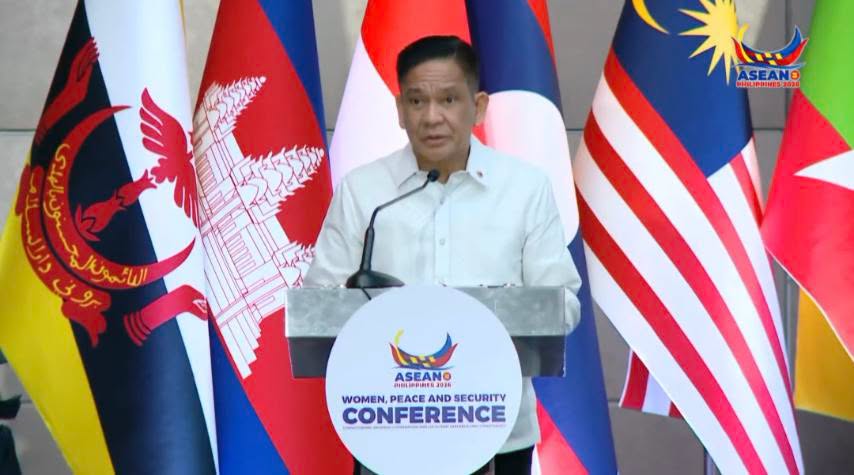
“This is why we are pursuing an Executive Order to institutionalize the localization of our National Action Plan on Women, Peace and Security. We want WPS integrated into local planning, budget planning, service delivery, and peacebuilding,” Sarmiento said during the opening of the ASEAN Women, Peace and Security Conference.
“We want local governments to develop action plans grounded in their communities’ needs,” he added.
Around 300 delegates from Southeast Asian countries gathered for the conference under the theme “Advancing Women, Peace and Security in ASEAN: Strengthening Regional Cooperation and Localizing Peacebuilding Commitments.”
Sarmiento said bringing the WPS agenda closer to communities would help ensure that women’s experiences and leadership are reflected in decisions that directly affect their lives.
He said the government’s peace agenda goes beyond completing signed peace agreements and includes ensuring that communities experience greater security, economic opportunities and meaningful participation in shaping their future.
“This is where women’s participation and the localization of the WPS Agenda become essential,” Sarmiento said.
He also emphasized the need to strengthen participatory governance and maintain inclusive spaces where civil society and people’s organizations can take part in peacebuilding and decision-making.
Philippine Commission on Women Chairperson Ermelita Valdeavilla said women have historically taken leadership roles in resolving disputes and building peace, even when their contributions have not always received formal recognition.
“Mediation, in our oldest traditions, was women’s work and it was respected and recognized as leadership,” Valdeavilla said, urging ASEAN countries to give greater recognition to women peacebuilders.
Department of Foreign Affairs Undersecretary Maria Theresa Dizon-De Vega, representing Foreign Affairs Secretary Ma. Theresa Lazaro, said women across Southeast Asia continue to play important roles in conflict prevention, peacebuilding and post-conflict recovery despite being particularly vulnerable during periods of conflict.
She said the Philippines continues to advocate gender-responsive peacebuilding and greater participation of women in peace negotiations and decision-making.
“Leadership transcends gender and an inclusive ASEAN holds space for everyone,” Dizon-De Vega said.
ASEAN Secretary-General Kao Kim Hourn, meanwhile, described the conference as another milestone in the regional bloc’s Women, Peace and Security efforts.
ASEAN member states formally advanced the regional agenda through the Joint Statement on Promoting Women, Peace and Security in ASEAN, adopted during the Philippines’ ASEAN chairship in 2017.
Kao said the ASEAN 2045: Our Shared Future framework continues that direction by envisioning women as fully empowered participants in decision-making, an objective he said has become increasingly important as the regional security environment evolves.
Representatives from Australia and the United Nations Development Programme also emphasized the importance of sustained partnerships in translating regional commitments into concrete programs at the community level.
The conference provides ASEAN member states and development partners a venue to review progress, identify challenges and strengthen cooperation on the WPS agenda.
As ASEAN Chair in 2026, the Philippines is pushing for stronger regional cooperation to expand women’s meaningful participation and leadership while ensuring peacebuilding initiatives are grounded in the needs and realities of local communities.