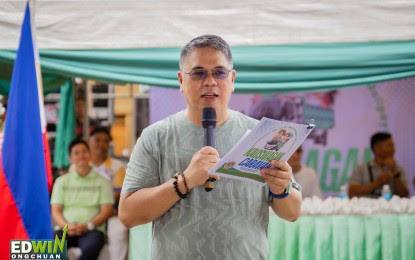

File photo of Northern Samar lawmaker Edwin Ongchuan from the Philippine News Agency.
CATARMAN, Northern Samar — Over the years, there have been many discussions over the viability of the Pantawid Pamilyang Pilipino Program (4Ps) which has been at the forefront of the national government’s initiatives since it’s inception as a priority project to reduce poverty through investments in health and education.
Discussions on the matter have highlighted the need to complement financial assistance with pathways to long-term self-sufficiency and House Bill No. 604, recently filed by Northern Samar’s District II representative Edwin Marino Ongchuan responds to this call through a timely and transformative proposal that places livelihood and skills development at the very core of social protection.
Ongchuan noted that at the focal point of this proposed amendment to Republic Act No. 11310 is the belief that government support must not end with cash but must evolve into capability.
The lawmaker explained that under the proposed bill, 4Ps beneficiaries will be required to complete at least two accredited livelihood or skills training programs. Thus, with the new direction, the program will becredifined into one that empowers families to become active contributors to the economy and not just recipients of doleouts candy-coated as government assistance.
“This shift is particularly relevant in provinces like Northern Samar, where agriculture and aquaculture offer rich yet underutilized opportunities for income and food security. In many rural communities, families have access to land and waterways yet lack the technical knowledge, tools, or market access to turn them into sustainable livelihoods. With proper training and government linkages, those capable of planting vegetables, raising livestock, or managing fishponds can be capacitated to produce, sell and grow,” the congressman pointed out.
To expound clearly, he described how a beneficiary, who once relied solely on monthly cash grants, would now be able to manage a productive fish cage or cultivate organic vegetables for sale in the local market. And according to Ongchuan, this is not just a vision but rather a long-term promise of progress committed to the marginalized sectors of our society.
“This is the promise of HB 604. Through partnerships with agencies such as TESDA (Technical Education and Skills Development Authority), DTI (Department of Trade and Industry), Department of Agriculture (DA), DoST (Department of Science and Technology) and even LGUs (local government units), the bill ensures that 4Ps families are connected to real, practical and sustainable income-generating activities,” he cited.
“In recent years, Northern Samar, for instance, has been gaining momentum in promoting micro-enterprises and community cooperatives in agriculture, fishery, and ecotourism industries through various provincial programs and HB 604 can complement these efforts by equipping 4Ps beneficiaries with the right skills and connecting them to local livelihood clusters and support networks,” he enthused.
In ending, Ongchuan asserted that his proposed bill will not take away support but instead transforms it by keeping the core purpose of 4Ps intact, which is to help families in need while reframing the relationship between the state and its citizens, from passive dependence to active partnership.
“It tells every parent and youth in the program: you are capable and we will help you realize it,” he stressed to conclude.