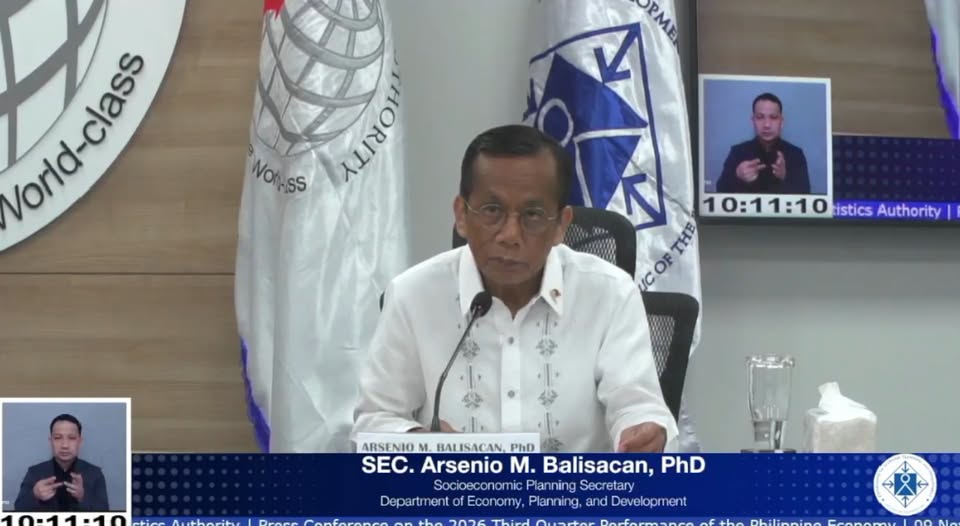

(Photo courtesy of PNA)
MANILA — The government will pursue urgent economic reforms to revive investment, accelerate infrastructure projects and ease rising living costs after Philippine economic growth slowed to 2.1 percent in the third quarter of 2026, Department of Economy, Planning, and Development (DEPDev) Secretary Arsenio Balisacan said Monday, November 9.
Data from the Philippine Statistics Authority (PSA) showed that gross domestic product (GDP) growth eased from 2.4 percent in the second quarter and 4 percent in the same period last year.
Balisacan attributed the slowdown to elevated food and energy prices, weaker household spending, declining investment and weather-related disruptions to agricultural production.
Household final consumption expenditure increased by 2.4 percent, slower than the 4 percent growth recorded a year earlier, as higher prices limited consumer spending.
Investment contracted by 0.2 percent amid tighter financing conditions, while the agriculture sector declined by 4.8 percent following damage caused by tropical cyclones and the enhanced southwest monsoon.
Public construction also continued to weaken, although private construction posted modest growth.
“Weather disruptions and delays in project validation and payments constrained infrastructure delivery. These delays affected contractors’ capacity to pay workers, purchase materials, and undertake further work. Governance concerns and uncertainty also weighed on confidence,” Balisacan said.
Despite the slowdown, exports grew by 8.6 percent, supported by a 19.4 percent increase in electronic exports.
Balisacan said achieving the government’s economic growth target of 5 to 6 percent next year remains possible, provided investment improves, inflationary pressures ease and business confidence recovers.
“Recovery toward next year’s 5 to 6 percent target remains possible but requires stronger investment, easing price pressures, and renewed confidence. Energy shocks, El Niño, and implementation delays remain risks,” he said.
“Our policy priorities are clear. Today’s report calls for urgent action to address the bottlenecks holding back investment and implementation, and restore stronger growth,” he added.
To encourage investment, Balisacan said the government would prioritize predictable economic policies, fiscal discipline, streamlined approval procedures, fewer redundant requirements and greater integration of digital systems.
He also emphasized the need to speed up infrastructure development to generate employment and stimulate economic activity.
“The President has directed agencies to fast-track implementation-ready projects, address bottlenecks in procurement and project execution, and expedite the processing of legitimate payment claims while maintaining proper safeguards and accountability,” Balisacan said.
The government will also coordinate with Congress to ensure the timely passage of the national budget while protecting funding for infrastructure and essential social services.
“A credible fiscal program must protect productive infrastructure and essential social services, supported by better revenue collection and reduced waste,” he said.
Food and energy security will remain major priorities, particularly as the country prepares for the possible effects of El Niño.
Balisacan said the government would expand climate-resilient agricultural programs, including the distribution of drought-resistant seeds, installation of solar-powered irrigation systems, crop insurance and assistance for affected farmers and fisherfolk.
The Department of Energy, meanwhile, is accelerating planned power projects, strengthening reserve capacity and coordinating with international partners to secure fuel supplies.
Targeted and time-bound assistance will also be provided to vulnerable households and sectors affected by rising prices and economic disruptions.
On trade and investment, Balisacan said the Philippines is strengthening engagement with the European Union, Canada, Japan, Chile and the United Arab Emirates to expand market opportunities and attract investments.
The government will also support exporters and encourage greater participation in regional and global supply chains.
Tourism development is another priority, with plans to expand direct international flights, improve airport capacity and strengthen promotional campaigns.
“We must also strengthen our tourism through expanded direct flights, improved airport capacity, and effective promotions that attract visitors and encourage longer stays,” Balisacan said.
The DEPDev chief stressed that restoring stronger economic growth would require coordinated government action to address implementation delays, strengthen investor confidence and protect households from persistent price pressures.