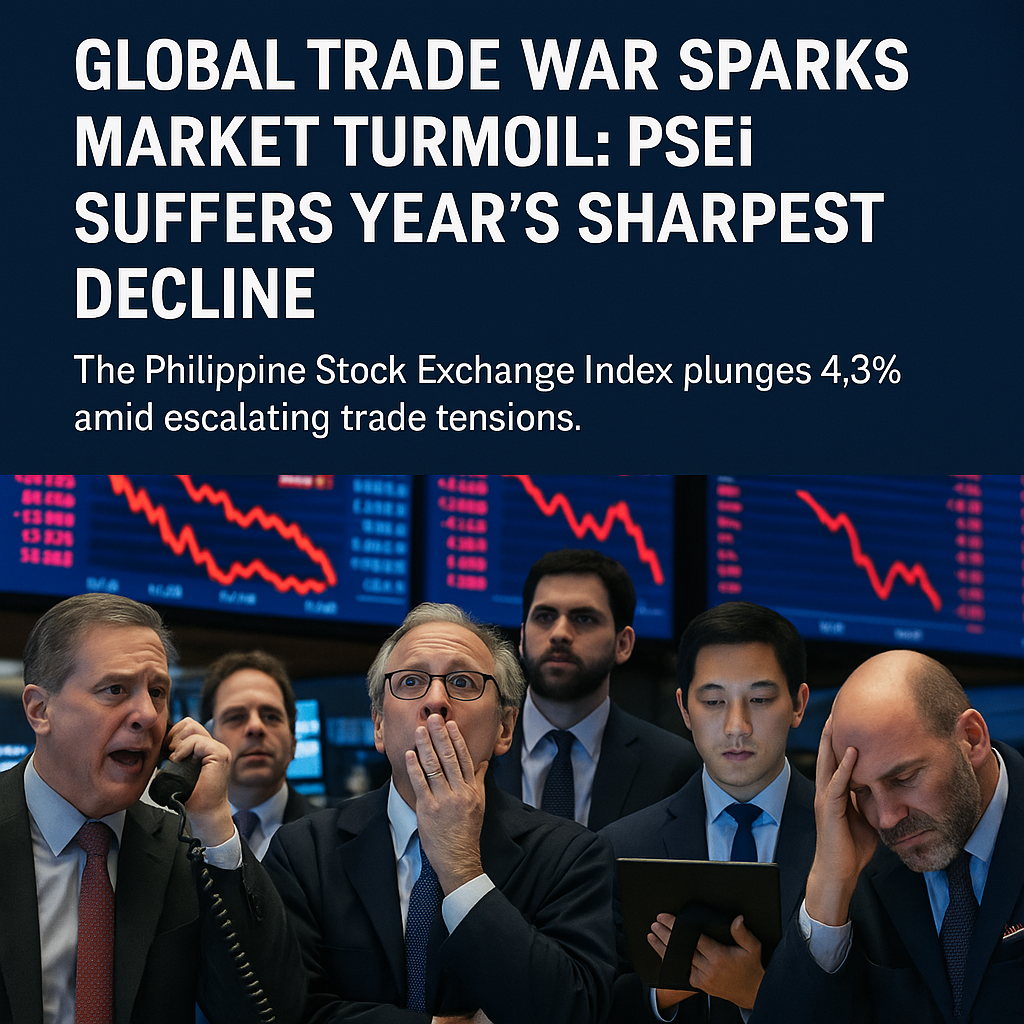

The Philippine Stock Exchange Index (PSEi) nosedived on Monday, logging its steepest loss of 2025 as escalating trade tensions rattled investors across Asia and beyond.
By day’s end, the PSEi had plunged 261.34 points, or 4.3 percent, closing at 5,822.85—a level not seen in months. It was the worst single-day drop this year, surpassing the 4-percent tumble recorded on January 31, when inflation and sluggish economic data last spooked markets. The broader All Shares Index wasn’t spared either, dropping 146.67 points, or 4.03 percent, to 3,496.77.
Luis Limlingan, head of sales at Regina Capital Development Corp., attributed the sell-off to fears ignited by fresh tariffs from China, which slapped a 34-percent duty on U.S. imports late last week. That move was seen as a direct retaliation to the aggressive protectionist stance maintained by Washington.
“The fear is that this tit-for-tat approach could snowball into a full-blown global trade war,” Limlingan said. “There’s also growing concern that this could tip the world economy into a recession.”
Wall Street had already taken a bruising ahead of Monday’s Asian session. On Friday, the Dow Jones Industrial Average, S&P 500, and Nasdaq Composite all sank more than 5 percent, as investor anxiety peaked over the potential fallout from the escalating tariff battle.
Across Asia, markets opened the week deep in the red. Japan’s Nikkei 225 plunged by a staggering 6.5 percent in early trading. Taiwan’s benchmark dropped nearly 10 percent, while Singapore’s main index shed 8.5 percent. Oil prices also joined the downtrend, with U.S. crude falling below $60 per barrel—a price not seen since April 2021.
The pain wasn’t limited to the Far East. On Sunday, before many Asian markets even opened, Saudi Arabia’s stock exchange recorded its worst day since the pandemic began, dropping 6.78 percent, according to local media.
Despite mounting alarm among investors, U.S. President Donald Trump downplayed the market rout. Speaking to reporters aboard Air Force One, he denied triggering the sell-off and framed the situation as necessary for long-term gain.
“Sometimes, you have to take medicine to fix something,” he said, adding that he was engaging with global leaders to reach trade agreements. “They’re dying to make a deal,” Trump claimed.
Meanwhile, Trump’s economic adviser Peter Navarro tried to reassure investors, asserting that the market volatility was temporary. “You can’t lose money unless you sell,” Navarro said, predicting that the U.S. would soon witness “the biggest boom in the stock market we’ve ever seen.”
Not everyone shares Navarro’s optimism. Former Obama administration economic chief Larry Summers warned that the market turbulence seen in recent days could be a sign of more volatility ahead.
“There’s a very good chance we haven’t seen the end of this,” Summers cautioned.
As global markets brace for what could be a prolonged period of uncertainty, analysts say investor focus will now turn to upcoming economic data and any signs of diplomatic breakthroughs that might ease the growing trade tensions. Until then, the ride looks far from over.