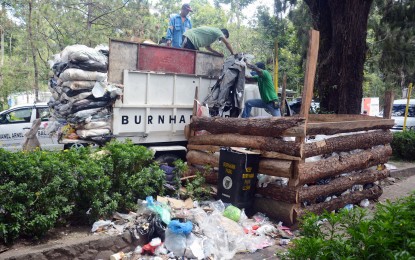
The management of an engineered sanitary landfill in Porac, Pampanga has agreed to accept garbage from Baguio following the closure of the facility in Urdaneta, Pangasinan which led to the stoppage of waste collection.
Margie Della, assistant head of the city government’s General Services Office (GSO), announced in a press conference late Wednesday afternoon that they were able to finalize the contract with Primewaste Solution Engineered Sanitary Landfill (PSESL) on Tuesday which will allow the resumption of garbage collection in the 128 barangays of Baguio City.
“There will already be a collection on Thursday but those whose garbage was not collected from Monday to Wednesday, they will resume collection on their schedules next week,” she said.
Della added that the Porac facility is about 200 kilometers away from Baguio, much farther than Urdaneta, Pangasinan which will double the transport cost from PHP800 to PHP1,600 per ton.
She said they were able to negotiate a lower tipping fee of PHP550 per ton compared to the PHP650 per ton in Pangasinan.
“This is farther and we will spend more but there is no other place to go and bring the residual wastes of the city,” she said.
The city spends an average of PHP200 million a year for the hauling and tipping fee of some 200 to 250 tons of garbage daily.
Long-term plan
Meanwhile, Della said the city has an ongoing development of a central materials recovery facility (MRF) at the higher portion of the existing transfer station of the city along Marcos Highway.
“In two to three years, by 2028, we expect to complete the site development of the three hectare facility which will serve as our long term solution to our garbage problem,” she said.
Among the activities to be undertaken at the central MRF is the processing of paper that can be used as feedstock.
“Matagal na ito per dapat mag practice na tayo ng maayos na segregation para makatulong tayong lahat sa pagbaba ng basura at maka-save sa gastusin (This has been going on for a long time but we need to do proper waste segregation to contribute in reducing the cost of waste management),” Della said.
She noted that segregation also leads to health solutions as it prevents flies and rodents from breeding and feeding on garbage.
“Currently, the segregation compliance rate is below 50 percent. We have not achieved the status where residents do segregation at source. Mekos-mekos pa rin ang basura natin (we still have mixed garbage),” Della said.
She added that once segregation is perfected, there will be lesser garbage to be brought to the landfill.