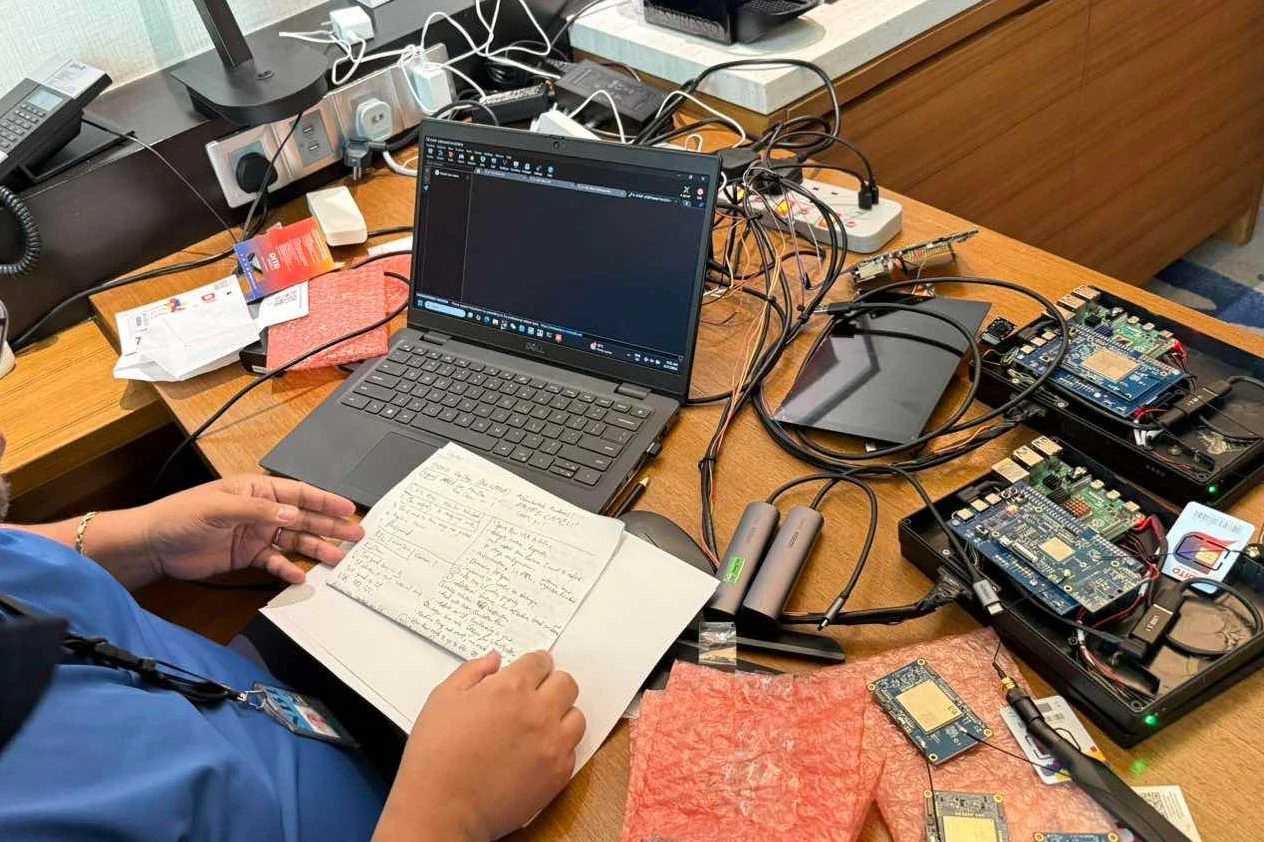

Two foreign nationals are now in custody for immigration violations after hotel staff grew suspicious of the unusual devices they left behind in their room. (Photo: NBI-7)
Authorities in Cebu have uncovered what they believe to be part of a sophisticated cyber-espionage and scam operation involving foreign nationals posing as tourists.
The National Bureau of Investigation (NBI), through its Cybercrime Investigation and Coordination Center, seized an array of unregistered surveillance and network interception devices from two Malaysian-Chinese nationals staying at a hotel in the North Reclamation Area.
The suspects were initially flagged after hotel staff reported unusual equipment left inside their room. Acting on the tip, the NBI obtained a warrant to search, seize, and examine the digital devices. Inside, they found antennas, modular setups, and advanced “sniffers” — tools capable of intercepting, monitoring, and analyzing network traffic.
“These devices can be used for legitimate purposes such as network diagnostics,” the NBI explained, “but in the wrong hands, they can be exploited to capture sensitive personal or financial information.”
Investigators suspect the duo was involved in the illegal distribution and use of high-powered transceivers, equipment that lacked approval from the National Telecommunications Commission (NTC).
According to the NBI, this incident highlights a disturbing trend: cybercriminals are shifting their operations away from fixed offices or residential spaces and moving into transient locations such as hotels and resorts. This tactic allows them to operate discreetly, minimize detection, and quickly change locations.
The two suspects were taken into custody for immigration violations while authorities prepare additional charges for possible breaches of the Cybercrime Prevention Act of 2012 (RA 10175). The confiscated devices will undergo a thorough forensic examination to determine the extent of their activities.
“This is not just a case of illegal gadgets,” an NBI official stressed. “It’s a reminder that cybercrime has become increasingly mobile, global, and deeply embedded in everyday environments. Even a luxury hotel can turn into a command center for illicit operations.”
The investigation is ongoing, with authorities exploring potential links to larger transnational cybercrime networks operating in Southeast Asia.