
Foreign investors continue to deepen their footprint in the Philippine economy, with fresh capital flowing into key growth sectors and reinforcing confidence in the country’s medium-term prospects.
Data released by the Bangko Sentral ng Pilipinas (BSP) showed that foreign direct investments (FDIs) recorded net inflows of $897 million in November 2025, reflecting sustained investor interest in Philippine-based operations despite global economic headwinds.
The November inflows were driven largely by equity capital and reinvested earnings, with South Korea emerging as the biggest source of investments during the month. A significant share of these funds was directed to the manufacturing sector, underscoring the Philippines’ continued appeal as a production and supply chain hub in the region.
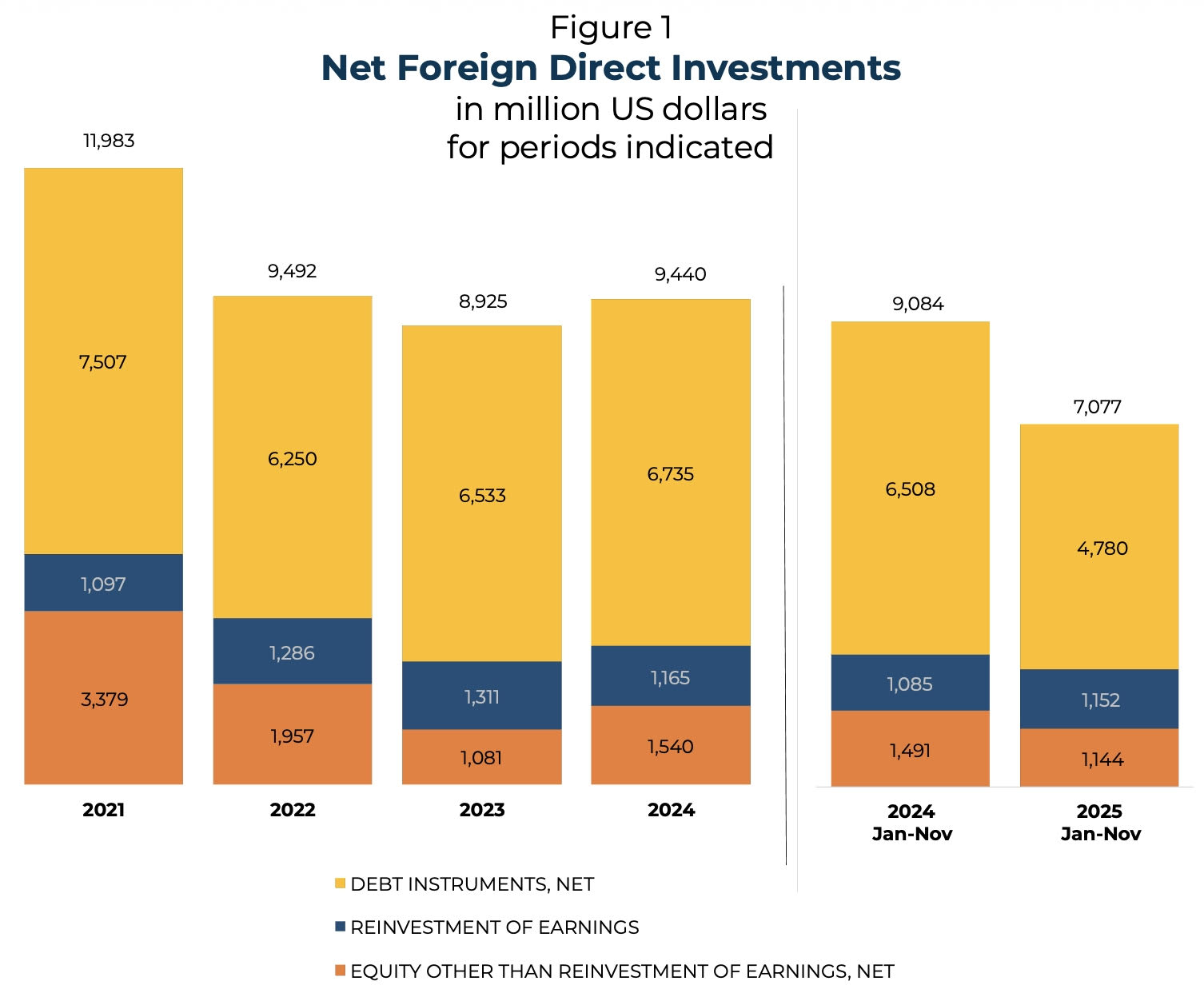
The strong monthly performance helped push cumulative FDI net inflows to $7.1 billion for the January to November 2025 period, maintaining a steady pace of capital formation across a wide range of industries.
For the first eleven months of the year, equity capital placements were sourced primarily from Japan, the United States, Singapore, and South Korea. These investments were channeled mainly into manufacturing, wholesale and retail trade, and real estate—sectors closely linked to domestic consumption, infrastructure expansion, and export-oriented activity.
Manufacturing remained a cornerstone of foreign investor interest, benefiting from ongoing industrial upgrades, supply chain diversification strategies, and the Philippines’ young, skilled labor force.
Meanwhile, continued inflows into wholesale and retail trade point to confidence in the resilience of domestic demand, while investments in real estate signal optimism about long-term urbanization and commercial development trends.
Analysts note that the diversified sources of equity capital reflect broad-based international confidence rather than reliance on a single major economy. The presence of investments from both East Asian and Western partners highlights the Philippines’ strategic position within regional production networks and global value chains.
The year-to-date FDI tally also comes amid government efforts to enhance the country’s investment climate through regulatory reforms, infrastructure acceleration, and fiscal incentives targeted at high-value industries. These structural measures are designed to strengthen competitiveness and attract long-term, job-generating capital.
While monthly FDI flows can fluctuate due to the timing of large transactions, the cumulative $7.1-billion inflow through November suggests that foreign investors continue to view the Philippines as a viable and expanding market in Southeast Asia.
With one month left in the reporting period, the trajectory of foreign investments indicates that 2025 is poised to close on a solid note, reinforcing the role of FDI as a critical driver of technology transfer, employment creation, and sustainable economic growth.