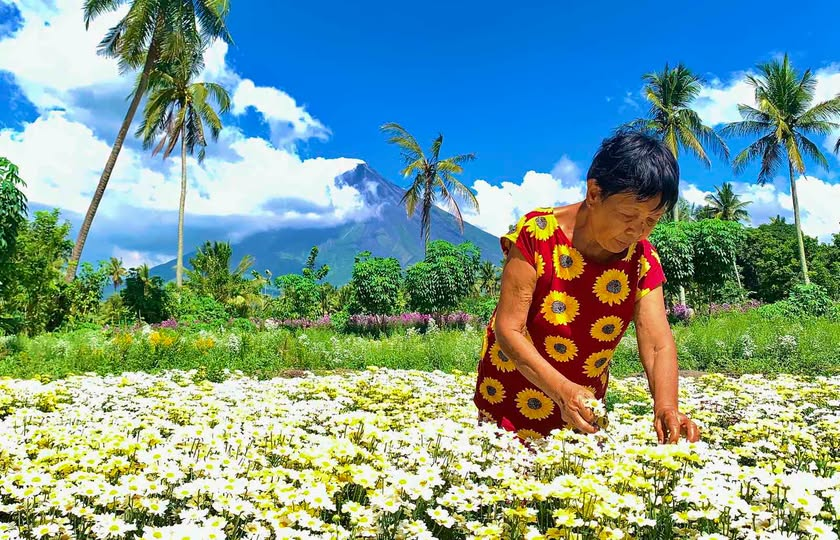

LEGAZPI CITY – Long before families bring flowers to cemeteries during Undas, Alice Miras, 72, and her husband Salvador, also 72, are already tending the plants that have sustained their family for about four decades.
The couple turned to flower farming after struggling to earn enough from growing vegetables. Their farm in Alcala, Daraga, Albay, now supplies customers in parts of Bicol and other provinces, with Undas among the busiest seasons of their livelihood.
For many, flowers symbolize remembrance and love placed on the graves of loved ones. For Alice and Salvador, they have also provided a livelihood that supported their seven children’s education through years of planting, harvesting, and selling.
“All of them finished their studies because of our flower farming,” Alice said.
Three of their seven children completed college, while their youngest now works as a librarian.
The couple initially grew vegetables such as tomatoes and bitter gourd, but earnings were often insufficient because much of their income went to pesticides and other farm inputs. They eventually turned to flower farming, which eased their financial burden and provided a more reliable way to support their children’s schooling.
For about 40 years, they have timed their planting to meet demand during major occasions. They begin planting in July so the flowers are ready for Undas, then prepare another crop for Holy Week. Valentine’s Day is also a peak season, while demand is lower on Mother’s Day.
Their farm covers about a hectare, though they plant only portions with flowers at a time. They also grow rice in other sections, rotating crops as the soil is prepared for the next planting cycle. To reduce the need to buy seedlings, they replant young plants left after harvesting.
The farm grows Malaysian mums in purple, white, and yellow; pink and white baby’s breath; celosia, locally known as palong-manok; and yellow goldenrod.
Alice and Salvador tend the plants themselves, watering them by hand and monitoring their condition closely because flowers can wilt without proper care. Still, some are lost to wilting, mold, and other forms of deterioration.
More than a livelihood built over the years
Over the years, the couple has built a network of regular buyers in Gubat and Irosin, Sorsogon; Sto. Domingo and Bacacay, Albay; and Samar, Masbate and Rapu-Rapu. They previously supplied customers in Virac, Catanduanes.
Some buyers collect their orders at the couple’s home in Matnog, Daraga, while others wait for deliveries. Any flowers left after harvesting are sent to customers in Sorsogon. Undas brings their strongest sales, followed by Holy Week, when flowers are also used in religious processions.
Alice said she is happy when customers visit their farm and when people appreciate the flowers posted on social media.
That recognition has given her a deeper sense of purpose. Knowing that buyers return for important occasions makes planting feel like more than a way to earn a living, she said.
“Planting flowers for every special occasion has become a moral obligation for me,” she said.
Many customers buy their flowers to place on the graves of departed loved ones. Alice said knowing that people seek out their farm for these visits motivates her to continue planting for Undas and other occasions.
The flowers have become part of other families’ traditions of remembrance, while the work behind them has sustained the Miras family for decades.
Recovering from losses
The couple’s livelihood remains vulnerable to unpredictable weather. Alice recalled that heavy rains during the previous Undas season knocked down plants and caused flowers to rot, resulting in lower earnings despite the money they had spent on farm inputs.
This year, more moderate weather has allowed their plants to grow and bloom better, giving them hope of recovering some of their losses.
Although they have yet to calculate their total earnings, Alice remains grateful for the improved crop and continues to trust in God as they face farming’s uncertainties.
“Thank you, Lord, because we may now recover some of our losses,” she recalled saying as she saw the plants growing better.
For Alice and Salvador, faith remains an important source of hope as they contend with changing weather and the challenges of maintaining their livelihood. Despite the uncertainty, they continue tending the farm and preparing flowers for customers during Undas and other special occasions.
Hoping for more seasons together
After 50 years of marriage, Alice said their relationship has grown stronger through years of helping one another. Working side by side on the farm has become part of their life together as they prepare flowers for Undas, Holy Week and Valentine’s Day each year.
Looking ahead, she hopes they will remain healthy and enjoy a peaceful life so they can continue tending their plants together for many more special occasions.
“I hope we can continue living peacefully and remain strong and healthy, so that next year, we can still plant flowers together for many more special occasions,” she said.
For Alice, growing flowers means sustaining their livelihood while serving customers who have relied on their farm for years. Despite unpredictable weather and previous crop losses, she hopes future harvests will help them recover financially and continue supplying flowers during peak seasons.
As they prepare for another Undas season, Alice and Salvador remain determined to keep farming for as long as their health allows. For the couple, the years ahead mean continuing the work they have shared for decades and planting flowers together for many more occasions. (Connie Calipay/PNA)