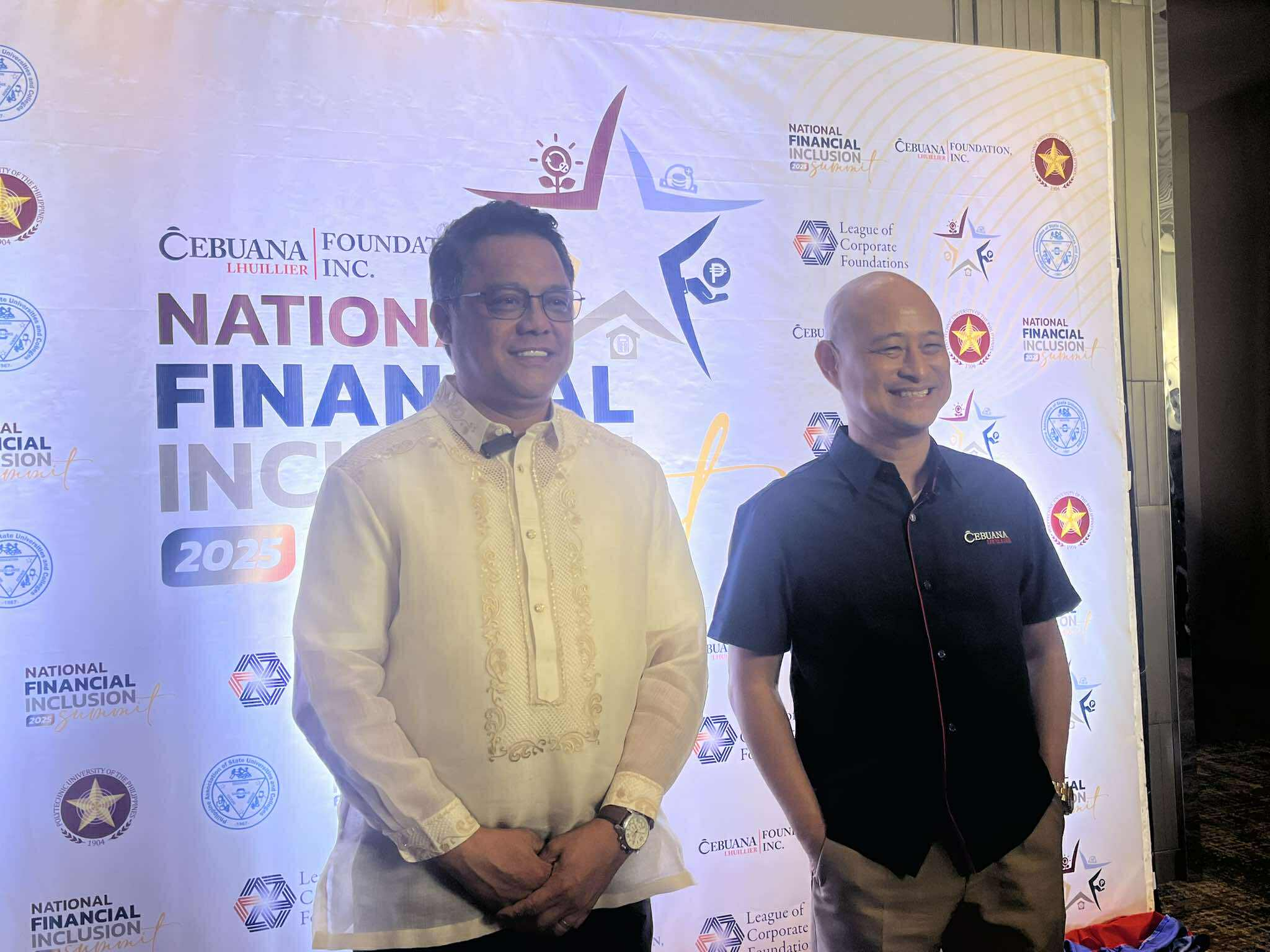

From left: PUP President Manuel M. Muhi and CLFI Executive Director Jonathan D. Batangan.
A call for inclusive, nationwide progress filled Novotel Manila in Quezon City as Cebuana Lhuillier Foundation, Inc. (CLFI) led the National Financial Inclusion Summit 2025, co-presented by the Polytechnic University of the Philippines (PUP), the Philippine Association of State Universities and Colleges (PASUC), and the League of Corporate Foundations (LCF). This year’s theme, #LahatKasama: Strengthening Financial Inclusion through Education, underscored a collective push to anchor financial empowerment in every Filipino classroom.
In a country where nearly half of adults remain unbanked and only 27 percent of young people aged 15 to 19 maintain a formal financial account based on BSP data, education remains the most powerful bridge toward financial resilience. CLFI and its partners emphasized that inclusion cannot be achieved through access alone—it must begin with understanding.
Teachers, school leaders, and educational institutions serve as the first line of financial empowerment, equipping Filipinos with not only tools but also the aptitude to make sound, responsible decisions.
“Access opens the door, but education teaches people how to walk through it and build new ones for others,” said Jean Henri D. Lhuillier, President and CEO of PJ Lhuillier Group of Companies. “When budgeting, saving, and planning become part of everyday learning, we create not just smarter students, but financially resilient citizens.”
PUP President Manuel M. Muhi reinforced this commitment by announcing that PUP will embed the new financial literacy course across its academic modules, particularly in programs involving marketing, business, and entrepreneurship, while emphasizing that every student—regardless of discipline—should graduate with a strong foundation in financial literacy.
Muhi added that the course is being prepared for inclusion in PUP’s Open University to widen nationwide access. He also plans to make the program available to overseas Filipino workers and micro, small, and medium enterprises, recognizing that financial empowerment must extend beyond campus walls and into the communities that drive the country’s economy.
Messages of support from LCF Chairperson Shem Jose W. Garcia and Senator Paolo Benigno A. Aquino IV followed, while Assistant Secretary Janir T. Datukan, representing Secretary Sonny Angara, delivered the keynote address on transforming schools into gateways of financial empowerment.
Throughout the day, speakers highlighted the urgent need to mainstream financial literacy nationwide. InvestEd Philippines Founder and CEO Carmina F. Bayombong shared insights on how affordable student financing can break long-standing barriers to access, while PIRA Executive Director Michael F. Rellosa emphasized the role of digital and inclusive insurance in building financial security. A panel moderated by PUP’s Dr. Ria S. Fajilago explored how academic institutions can make financial education a national strength across all regions and socioeconomic backgrounds.
In the afternoon sessions, PASUC President Dr. Tirso A. Ronquillo and Jean Henri D. Lhuillier discussed how financial literacy must be reinforced through policy and community partnerships. Bangko Sentral ng Pilipinas’ Atty. Charina B. Vera-Yap presented ongoing digital inclusion programs, while Xepto Education’s Dr. Francisco S. A. Sandejas and University of Makati’s Dr. Laarni Evelyn A. Santiago showcased technology-driven strategies to make financial learning both accessible and engaging.
The Summit’s highlight was the unveiling of the #LahatKasama Financial Literacy Module, a comprehensive digital toolkit designed for teachers nationwide. Covering practical topics such as saving, investing, and disaster preparedness, the module aims to make financial education a life skill rather than an abstract concept.
For CLFI Executive Director Jonathan D. Batangan, the Summit marks the beginning of a larger, long-term movement. Batangan said he expects the financial literacy ecosystem to expand beyond PUP and PASUC, welcoming other state universities and colleges, private institutions, and even financial institutions that can provide graduates with real financial access as they complete the program. He stressed that financial inclusion must be a continuum, not a one-time intervention.
“Financial inclusion is not just access. More importantly, it is empowerment. Through our partnerships with DepEd, CHED, TESDA, and our academic and corporate partners, we are turning classrooms into launchpads of empowerment. Every financial literacy lesson becomes a step toward a more resilient and inclusive Philippines.”
The Summit aligns with the Bangko Sentral ng Pilipinas’ National Strategy for Financial Inclusion 2022–2028 and supports the UN Sustainable Development Goals on education, poverty reduction, and decent work. But more than its policy connections, the event stands as a national commitment: to turn every teacher into a mentor of financial discipline, every campus into a hub of financial empowerment, and every learner into an advocate of resilience.
“Inclusion begins with education,” Lhuillier reminded the audience. “When financial literacy moves hand in hand with learning, we build communities capable not only of managing today’s challenges but of shaping a future where progress truly includes everyone.”