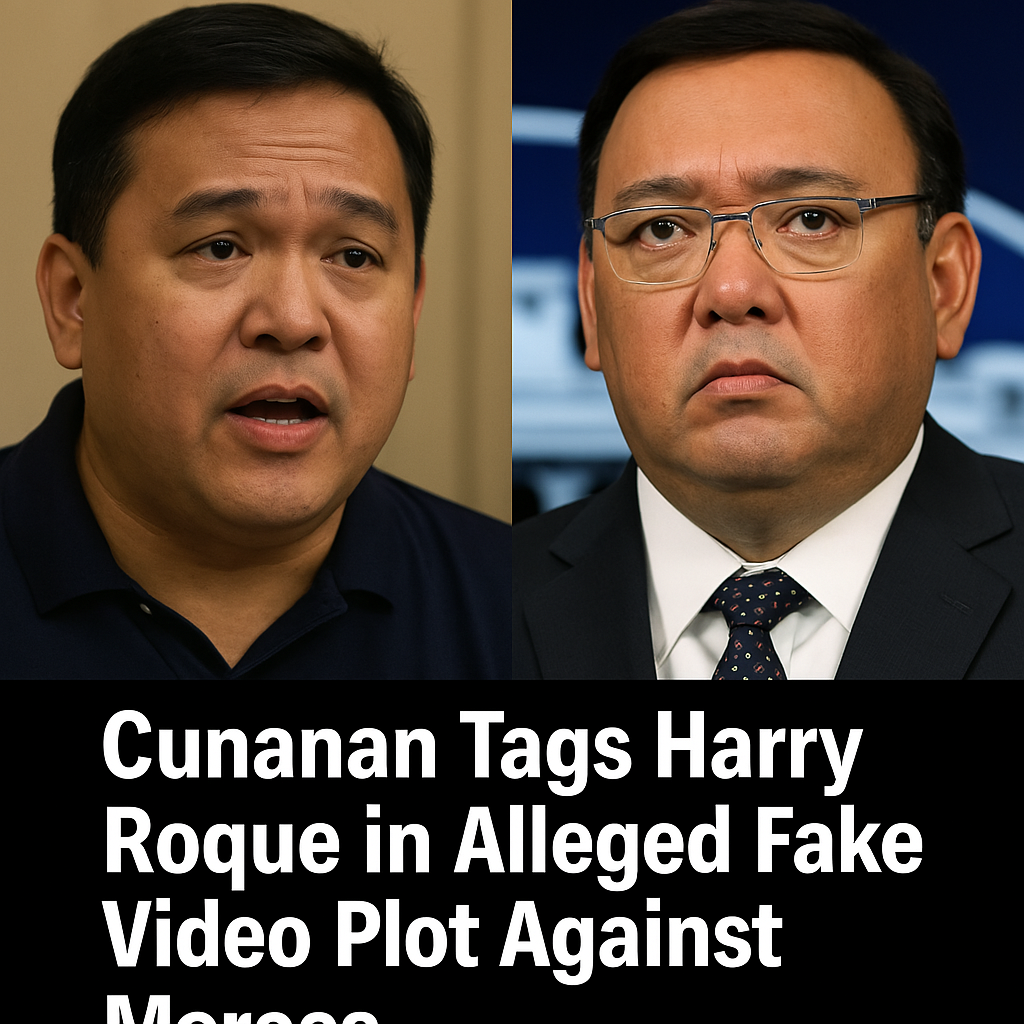

In a startling development that has reignited debates on digital misinformation and its dangers to democracy, social media influencer Vicente Bencalo “Pebbles” Cunanan has accused former presidential spokesperson Harry Roque of being the mastermind behind the controversial “polvoron video” — an alleged piece of fake content showing President Ferdinand “Bongbong” Marcos Jr. supposedly sniffing cocaine.
Cunanan’s claims were made under oath in a sworn affidavit submitted during the House Tri-Committee (Tri-Comm) hearing on fake news and digital disinformation. His revelations come at a time when Congress is grappling with the alarming proliferation of misinformation on social media, which lawmakers warn has reached crisis levels and now threatens the country’s democratic institutions.
A plot born over dinner?
According to Cunanan, the origins of the so-called “polvoron video” can be traced back to a private dinner held in Hong Kong on July 7, 2024, shortly after a pro-Duterte “Maisug Rally.” Cunanan claimed the gathering was attended by several controversial figures, including Roque, former Executive Secretary Vic Rodriguez, and other social media influencers and DDS (Diehard Duterte Supporters) personalities.
It was during this meeting, Cunanan stated, that Roque allegedly boasted, “Magaling ako magpabagsak ng gobyerno” (“I’m good at toppling governments”) — a remark Cunanan interpreted as an admission of a coordinated campaign to undermine the Marcos administration.
Roque reportedly claimed to have received a screenshot from a politician’s relative showing what appeared to be President Marcos using cocaine. Although the actual image wasn’t shown that evening, discussions were allegedly held on how to disseminate the video to the public while avoiding legal liability. The strategy, Cunanan said, involved leaking the video through foreign influencers to lend it credibility and shield its true source.
In a symbolic act during a photo session that night, the group reportedly posed with an inverted “V” hand gesture — a subtle mockery of the “V” sign Marcos Jr. popularized during his presidential campaign.
Strategic release before the SONA
Cunanan stated that the first public release of the video occurred during a Maisug Rally in Vancouver, Canada, on July 20 — a day before President Marcos delivered his State of the Nation Address (SONA). He claimed that DDS vlogger Maharlika had advance knowledge of the video and even urged him to “ride the wave” of controversy the footage would generate.
Two versions of the video were shared with Cunanan: a raw file and an “enhanced” one that appeared to have been edited to more clearly depict Marcos. Cunanan believes this manipulation further proves the premeditated intent to damage the President’s reputation at a politically crucial moment.
“Sa aking pagkaintindi ay in-edit at in-augment ang video upang magmukhang si Pangulong BBM mismo ang nasa eksena,” Cunanan wrote in his affidavit, expressing certainty that Roque and several DDS-aligned figures deliberately propagated fake news to stir unrest and discredit the administration.
A broader crisis in the information ecosystem
The Cunanan-Roque controversy is just one part of a much broader problem that lawmakers are now urgently addressing. During the same Tri-Comm hearing, Surigao del Sur Rep. Johnny Pimentel emphasized that digital disinformation has reached “crisis proportions” and poses a direct threat to Philippine democracy.
Pimentel noted how algorithm-driven platforms and the psychological allure of sensational content have fueled an environment where lies spread faster than facts. He warned that politically motivated fake news, especially with the 2025 midterm elections on the horizon, could distort public discourse and undermine faith in government institutions.
“We confront the daunting challenge of safeguarding our democracy and the integrity of our information ecosystem,” Pimentel said, adding that the committee aims not only to expose problems but also to craft solutions — including education, regulation, and technological intervention.
Accountability of social media platforms
Amid calls for greater responsibility from tech companies, Antipolo City Rep. Romeo Acop clashed with Meta’s Director of Public Policy for Southeast Asia, Dr. Rafael Frankel, over whether platforms like Facebook and Instagram bear responsibility for the fake content they host.
Despite repeated questioning, Frankel refrained from giving a clear yes or no answer, insisting that Meta balances freedom of expression with the need for content moderation. Acop, however, expressed frustration at what he saw as evasiveness, arguing that platforms must share some liability for the misinformation they enable.
“We are exploring the idea of requiring accreditation or registration for social media platforms operating in this country,” Acop said, pointing to the lack of a clearly accountable Meta entity in the Philippines as a loophole that needs addressing.
A fact-checked future?
In an effort to defend its content moderation, Meta cited actions taken against pro-Duterte blogger Mark Lopez, who falsely claimed the Philippine Coast Guard used water cannons against Chinese vessels. The claim was fact-checked and flagged as false by VERA Files — one of Meta’s local third-party fact-checkers alongside Rappler and Agence France-Presse.
However, such actions appear limited and reactive rather than systemic, and lawmakers remain unconvinced that the tech giant is doing enough.
Conclusion
The admission by Vicente Cunanan that Harry Roque may have masterminded the circulation of a fabricated and politically explosive video against President Marcos Jr. underscores the grave dangers of unchecked disinformation. It reveals not only the manipulative potential of fake news but also how it can be weaponized by influential figures for political gain.
As Congress pushes for accountability, both from individuals and from social media platforms, it’s becoming increasingly clear that combating fake news is not merely a tech issue — it is a fight for truth, public trust, and the integrity of Philippine democracy.