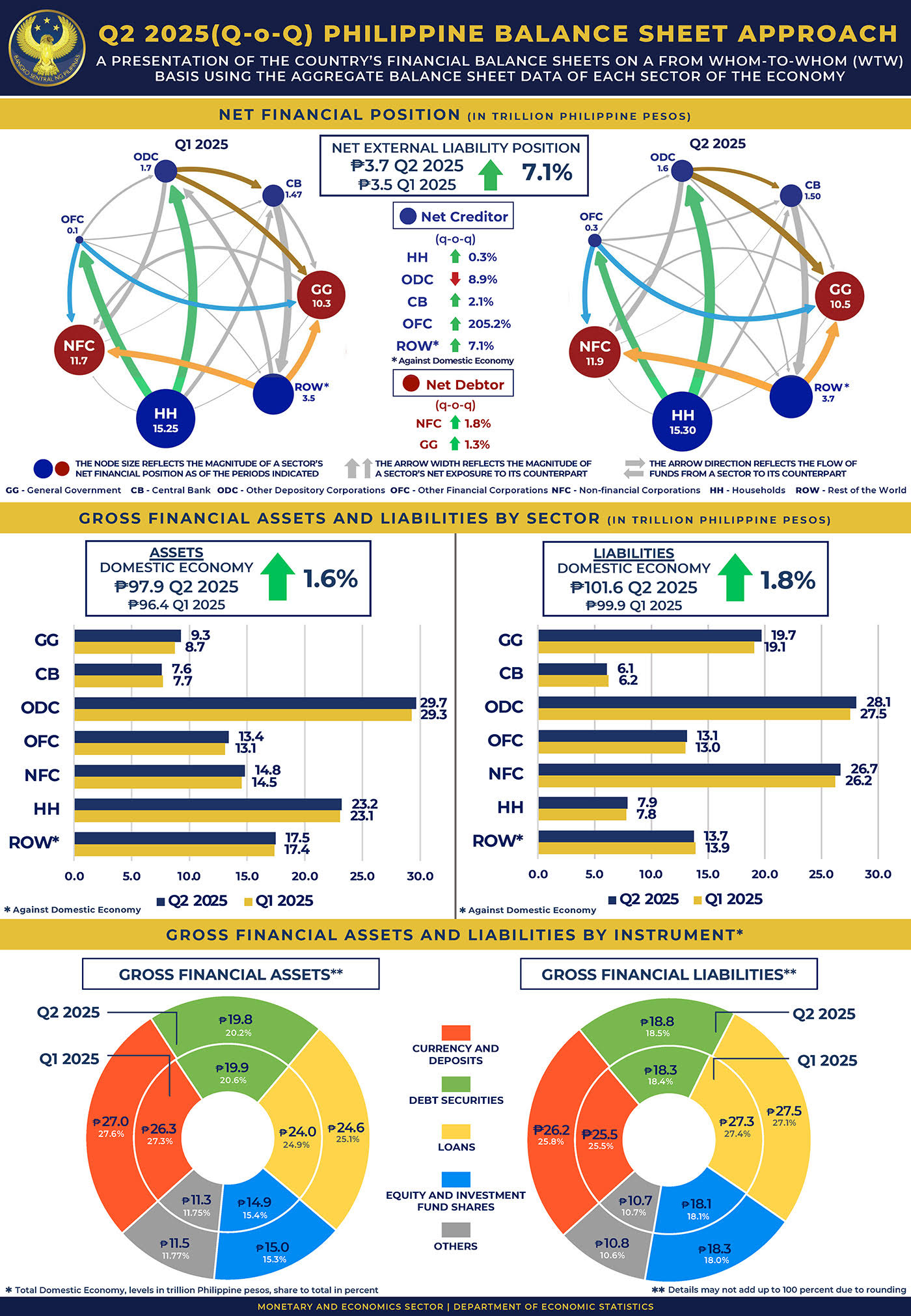

The Philippines’ net external liabilities expanded moderately in the second quarter of 2025, reflecting stronger access to foreign financing that continues to support corporate expansion and government development priorities.
Preliminary Balance Sheet Approach (BSA) data show that net external liabilities rose by 7.1 percent quarter-on-quarter to ₱3.7 trillion in Q2 2025, up from ₱3.5 trillion in the first quarter.
The increase was driven largely by higher external financing tapped by non-financial corporations and the government, alongside a decline in the central bank’s investments in debt securities issued by nonresidents.
Non-financial corporations accounted for a significant share of the increase, as their net debtor position widened on the back of higher equity and investment fund share liabilities to nonresidents and other financial corporations. Loans remained the sector’s primary funding source, followed by equity securities, underscoring continued confidence from foreign lenders and investors.
The rest of the world and domestic depository corporations remained the sector’s main financing partners, together accounting for nearly three-fourths of total outstanding liabilities.
The general government’s net debtor position also increased during the quarter, reflecting higher government securities held by domestic banks, nonresidents, and other financial corporations, as well as growth in loans owed to external creditors.
Despite this expansion, the structure of government obligations remained broadly favorable. About 70.1 percent of outstanding liabilities continued to be denominated in domestic currency, providing a natural buffer against exchange-rate volatility and reinforcing fiscal resilience.
The Balance Sheet Approach, developed by the International Monetary Fund in 2002, serves as a key financial stability surveillance framework by examining the stock of financial assets and liabilities across economic sectors at a given point in time.
By focusing on balance sheet positions rather than transaction flows, the BSA helps policymakers assess potential vulnerabilities while also highlighting areas of strength in an economy’s financial structure.
Overall, the Q2 2025 data suggest that the rise in the country’s net external liabilities reflects active participation in global capital markets, with external resources channeled toward corporate growth and public-sector financing needs, while maintaining safeguards that help manage external risks.