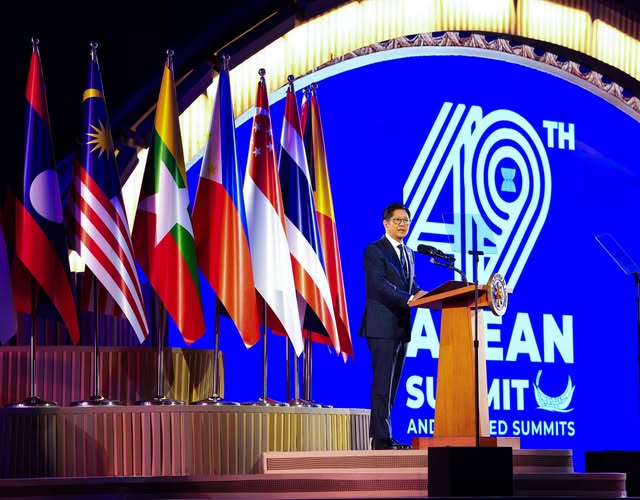

(Photo courtesy of PCO)
MANILA, Philippines – From a five-nation alliance established nearly six decades ago, the Association of Southeast Asian Nations (ASEAN) has expanded into an 11-member regional bloc representing more than 700 million people, with Timor-Leste joining as its newest member.
Despite its growing influence in regional diplomacy, trade, and economic cooperation, many Filipinos remain unfamiliar with ASEAN’s role and how its initiatives affect their daily lives.
Founded in August 1967, ASEAN comprises the Philippines, Indonesia, Malaysia, Singapore, Thailand, Brunei Darussalam, Vietnam, Laos, Myanmar, Cambodia, and Timor-Leste.
The organization’s chairship rotates annually among member states in alphabetical order, with the chairing country responsible for leading major meetings, including the ASEAN Summit and Related Summits.
The ASEAN Summit serves as the bloc’s highest policy-making body, where regional leaders discuss pressing issues and reach decisions through consensus.
Traditionally held twice a year, the meetings focus on internal regional priorities and broader cooperation with international partners.
Under its 2026 chairship, the Philippines hosted the 48th ASEAN Summit in May and the 49th ASEAN Summit in November.
How ASEAN benefits Filipinos
Beyond diplomatic engagements, ASEAN provides the Philippines with opportunities to advance national priorities, attract investments, expand trade, and strengthen cooperation on issues affecting ordinary citizens.
One of the major initiatives advanced under the Philippine chairship is the ASEAN Digital Economy Framework Agreement (DEFA), designed to establish common rules governing digital trade and economic activities across Southeast Asia.
Once implemented, the agreement is expected to help micro, small, and medium enterprises (MSMEs) reach customers in neighboring countries by improving digital connectivity and reducing barriers to cross-border transactions.
It could also generate employment opportunities in e-commerce, information technology, digital services, and creative industries.
ASEAN cooperation also supports efforts to improve energy security, protect migrant workers, promote women’s rights, and strengthen regional responses to economic and environmental challenges.
During its 2026 chairship, the Philippines advanced plans for a regional maritime center based in the country, greater energy connectivity through the ASEAN Power Grid, and stronger measures against child abuse and online exploitation amid the rapid development of artificial intelligence.
These initiatives aim to strengthen regional cooperation while addressing concerns that directly affect Filipino households, businesses, and communities.
A stronger voice in regional affairs
Former Philippine Permanent Representative to ASEAN Elizabeth Buensuceso said membership allows the Philippines to pursue its national interests on a broader international platform.
These priorities include maritime security, migrant workers’ welfare, women’s empowerment, and inclusive economic development.
“Chairmanships are occasions or opportunities when the chair is able to push for important deliverables for the region, not only for itself. Of course, it will benefit the country itself, but also the region, and sometimes the whole world,” Buensuceso said during a forum at the University of the Philippines Asian Center.
Through ASEAN, the Philippines can work with neighboring countries to address shared challenges that may be difficult to resolve independently.
Why consensus matters
ASEAN has faced criticism over its consensus-based decision-making process, which can delay action on sensitive regional issues.
However, supporters of the approach argue that giving every member state a voice helps preserve dialogue, manage disagreements, and prevent diplomatic tensions from escalating.
In her book, ASEAN Centrality: An Autoethnographic Account by a Philippine Diplomat, Buensuceso cited former Indonesian Foreign Minister Marty Natalegawa’s assessment of the organization’s contribution to regional stability.
“Without ASEAN, the past five decades could have been witness to an entirely different experience including incessant conflicts, distrust, animosity, and poverty,” she wrote.
For the Philippines, ASEAN membership provides a platform to pursue economic opportunities, strengthen regional partnerships, and address common security and development concerns.
While the benefits of regional cooperation may not always be immediately visible, ASEAN initiatives can influence employment, business opportunities, energy security, digital services, and the welfare of Filipinos working across Southeast Asia.