
Education Secretary Sonny Angara welcomed Congress’ ratification of the proposed National Children’s Nutrition Act, bringing the measure closer to enactment and paving the way for expanded feeding programs for millions of Filipino children.
The Senate and the House of Representatives ratified the bicameral conference committee report reconciling Senate Bill No. 2272 and House Bill No. 9466. The measure will now be transmitted to President Ferdinand Marcos Jr. for his signature.
Once enacted, the legislation will replace Republic Act No. 11037, or the Masustansyang Pagkain para sa Batang Pilipino Act, introducing structural reforms to address child malnutrition and improve learning outcomes.
“Sa pangunguna ni Pangulong Bongbong Marcos, malinaw na ang nutrisyon ay hindi lang usapin ng pagkain kundi ng edukasyon at kinabukasan. Hindi makakapag-focus at makakapag-aral nang mabuti ang batang gutom,” Angara said.
“Sa pagpapalawak ng feeding program na ito, hindi lang natin pinupunan ang kagutuman sa classroom, binibigyan natin ang ating mga mag-aaral ng lakas at kakayahan para makahabol, matuto, at magkaroon ng magandang bukas.”
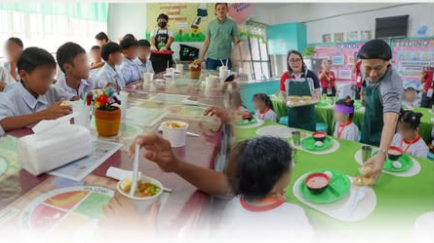
Under the proposed legislation, the Department of Education (DepEd) will implement universal feeding for all public school learners from Kindergarten to Grade 3, regardless of their nutritional status, while maintaining targeted feeding programs for undernourished learners in Grades 4 to 6.
The measure also extends coverage to pregnant adolescent learners in participating schools and allows DepEd to expand the program to vulnerable, undernourished and Indigenous Peoples learners under the voucher system, including those in self-contained classes and the Alternative Learning System.
The Department of Health (DOH) will oversee policy and program coordination, with the National Nutrition Council responsible for monitoring.
Meanwhile, the Department of Social Welfare and Development (DSWD), in partnership with local government units, will implement supplemental feeding programs for children aged two to below five years enrolled in the Early Childhood Care and Development system.
The proposed law also requires feeding allocations to be used exclusively for direct food costs and mandates agricultural procurement directly from local farmers and fisherfolk, in accordance with the Sagip Saka Act and the New Government Procurement Act.
The measure builds on the Marcos administration’s expansion of the School-Based Feeding Program, for which DepEd secured a record Php 25.6 billion for school year 2026–2027 to benefit 4.63 million learners. Feeding coverage was also extended from 120 to 200 days.
The congressional ratification coincided with the second Southeast Asia Regional School Meals Coalition Summit, co-hosted by DepEd, the World Food Programme and the global School Meals Coalition.
“Hosting this summit comes at an opportune time as we finalize our expanded school feeding legislation. Investing in feeding our children is investing in our nation’s long-term potential,” Angara said.