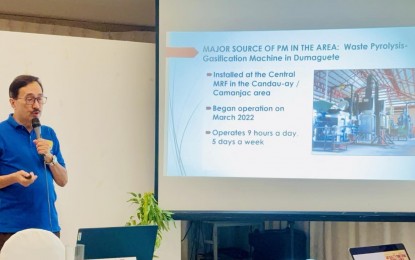
Environmental groups in Dumaguete City, Negros Oriental, have called on the newly elected city council members to shut down the pyrolysis incinerator amid concerns of a “looming public health crisis.”
During a press conference on Tuesday, the groups presented findings from a community-led air quality monitoring study that revealed “dangerously high levels of air pollution” attributed to the pyrolysis incinerator located at the city’s central Materials Recovery Facility (MRF) in Barangay Candauay.
Pyrolysis is a thermal decomposition process that breaks down organic materials at high temperatures in the absence of oxygen, converting them into gaseous, liquid, and solid components that can be used as fuel or further processed.
Dr. Jorge Emmanuel, an international environmental expert, emphasized the urgent need to halt the operation of the pyrolysis gasification machine, citing the risk posed to thousands of residents in Dumaguete and nearby towns such as Valencia and Sibulan from harmful toxins.
The pollutants emitted from incinerators include dioxins, heavy metals, acid gases, and semi-volatile organic compounds. “Although we could not measure other pollutants because of the cost, in every test I conducted of pyrolysis, gasification, and other incineration technologies, these other toxic pollutants were also always present,” Emmanuel stated.
He reported that the study indicated dangerously high levels of particulate matter (PM) from the pyrolysis incinerator, which operates for at least nine hours each day. The machine has been in operation since 2022, burning waste from 8 a.m. to 5 p.m., five days a week.
Emmanuel, a former United Nations Chief Technical Advisor on the environment, led the research team that utilized the AirBeam3, a portable air monitoring technology provided by GAIA (Global Alliance for Incinerator Alternatives). Seventeen community volunteers wore the devices for 9 to 10 days between October 2024 and February 2025.
The data collected showed that PM 2.5 concentrations exceeded the World Health Organization (WHO) 24-hour air quality guideline on 88 percent of monitoring days. PM 2.5, which are microscopic particles resulting from waste burning, are known to cause severe asthma, lung disease, cardiovascular illness, and premature death. Many of these pollutants are invisible, odorless, and can persist in the environment for years, with health effects that may not manifest until much later.
Merci Ferrer of WOW (War on Waste) – Negros Oriental noted that residents near the MRF facility have reported constant coughs and fatigue, which the report corroborates with hard data. She urged more barangays in the city to adopt Zero Waste practices, such as establishing MRFs and educating households on garbage segregation at the source.
So far, Barangays Looc, Bantayan, Piapi, Banilad, and Calindagan have implemented the Zero Waste program.
The environmental groups, including WOW – Negros Oriental, GAIA, and the National Anti-Poverty Commission, plan to formally present their report titled “Dangerous Particulate Matter from the Pyrolysis Incinerator at the Central MRF in Dumaguete” to the new city councilors, calling for the immediate shutdown of the pyrolysis incinerator and the full enforcement of environmental and public health laws.
Emmanuel also mentioned that a second pyrolysis machine is being considered in the city to manage the volume of waste brought to the central MRF. The environmental groups are urging the new city administration to expand the Zero Waste program to all 30 barangays.
The organizers of the #BurnNotDumaguete campaign emphasized that “this shift must be both equitable and sustainable” to protect the health and welfare of waste workers, waste pickers, and the surrounding communities.

