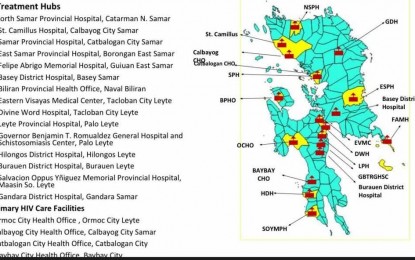


A map showing the location of HIV treatment centers in Eastern Visayas. From 1989 to April 2025, the region has logged 2,642 HIV/AIDS cases, with 175 deaths recorded since 2001, according to the Department of Health. (DOH Region 8 image)
PALO, Leyte – More treatment facilities have been established in Eastern Visayas in response to the rising number of human immunodeficiency virus /acquired immune deficiency syndrome (HIV/AIDS) cases in the region, the Department of Health (DOH) regional office said Friday.
From just 11 in 2022, the DOH said the region now has 20 treatment centers, including 15 hospitals and five city health offices that offer free testing and treatment services, including maintenance medications for HIV/AIDS patients.
“Screening can also be done in all our rural health units, allowing more people to avail free testing in their towns. We encourage those with risky behaviors to know their status since early detection is the best weapon against the virus,” Antonieta Diloy, DOH regional HIV program coordinator, said in an interview.
HIV treatment facilities are located at the Eastern Visayas Medical Center and Divine Word Hospital in Tacloban City; and Governor Benjamin T. Romualdez General Hospital and Schistosomiasis Center, Leyte Provincial Hospital, Burauen District Hospital, Baybay City Health Office, Hilongos District Hospital, and Ormoc City Health Office in Leyte province.
They are also located at Salvacion Oppus Yñiguez Memorial Provincial Hospital and Maasin City Health Office in Southern Leyte; Samar Provincial Hospital, Basey District Hospital, Calbayog City Health Office, St. Camillus Hospital, Gandara District Hospital, and Catbalogan City Health Office in Samar province; Eastern Samar Provincial Hospital and Felipe Abrigo Memorial Hospital in Eastern Samar; Northern Samar Provincial Hospital; and Biliran Provincial Health Office.
Since the start of case monitoring in 1989 until April 2025, the region has already logged 2,642 HIV/AIDS cases. A total of 175 patients have died from the illness since 2001, according to DOH.
Of the total cases, at least 141 new patients were found from January to April 2025 with 10 deaths.
Diloy said most patients are aged 15 to 24 years old, since they have more access to social media sites and online dating applications.
Diloy said there is still no cure for HIV infection. However, with increasing access to effective HIV prevention, diagnosis, treatment and care, virus infection has become a manageable chronic health condition, enabling people with HIV to lead long and healthy lives.
“The treatment hubs and care clinics provide accessibility, a system, and a mechanism to ensure a well-coordinated delivery of comprehensive services not only in the provision of the clinical case but also in support and prevention services, hence cutting the stigma on HIV,” she said.
HIV is a virus that attacks the immune system and if untreated, a person’s immune system will eventually be destroyed.
AIDS, on the other hand, refers to symptoms and illnesses that occur at the very final stage of HIV infection. (PNA)