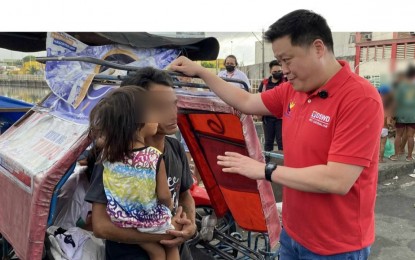
The Department of Social Welfare and Development (DSWD) is enhancing its efforts to assist families and individuals in street situations (FISS) in returning to their homes or places of origin through the Pag-Abot Program.
Secretary Rex Gatchalian emphasized on Tuesday that the Pag-Abot Program aligns with President Ferdinand R. Marcos Jr.’s directive to expand the DSWD’s reach and ensure that the most vulnerable populations are covered by social protection programs. In his 4th State of the Nation Address (SONA) on Monday, the President highlighted that families and individuals in street situations are among those most in need of government assistance, urging local government units (LGUs) to identify and register these families in various DSWD programs.
During the ‘Post-SONA Discussions on Health and Social Welfare Protection’ held at the Makabagong San Juan National Government Center in San Juan City, Gatchalian stated, “Kung mayroon tayong matatawag na mahirap sa pinakamahirap, yun yung mga families and individuals in street situations. Sila yung mga nakatira sa lansangan.” (If there is a group that we can call the poorest of the poor, these are the families and individuals in street situations. They are the ones living in the streets.)
The DSWD chief explained that over 100 Pag-Abot social workers are regularly deployed in Metro Manila, checking streets, overpasses, underpasses, and areas under bridges where FISS are commonly found. “Kinukupkop natin, kinukumbinse na sumama sa amin para panandaliang tumira sa ating shelter,” Gatchalian said, referring to a converted facility in Pasay City that was once a Philippine Offshore Gaming Operators (POGO) hub, now functioning as the Walang Gutom Kitchen and temporary shelter for the reached-out FISS.
Gatchalian clarified that the shelter located at the Nasdake Building is not a permanent home, as the goal of the Pag-Abot Program is to reintegrate the reached-out FISS into their families and communities. “Ang layunin natin ay maiuwi sila sa kanilang mga komunidad pero may sapat na interbensyon — kabuhayan o ano pang interbensyon na kailangan nila — para mag thrive sila at hindi na kailangang mapilitan pa na tumira sa lansangan.” (Our goal is to bring them back to their communities, but with sufficient intervention – livelihood or any other intervention that they need – for them to thrive and not be forced to return to the streets.)
He also noted that under the Pag-Abot Program, the national government is taking a more active role in assisting FISS. “Kung dati-rati, local government units ang nasa harapan sa pagtulong… ngayon ay national government na ang nakikipag-ugnayan sa LGUs.” (Previously, it was the LGUs that were in charge of assisting them… but now, it’s the national government that is coordinating with the LGUs.) Gatchalian highlighted that the Marcos administration is the first to institutionalize such a program at the national level.
Through a whole-of-government approach, Gatchalian stated that the DSWD aims to ensure that “walang Pilipinong maiiwanan, lalong-lalo na yung mga nasa lansangan.” (No Filipino would be left behind, especially those in the streets.)
Multi-Sectoral Approach
The Pag-Abot Program, initiated by the DSWD in 2023, was institutionalized through Executive Order 52 in January 2024. It adopts a multi-faceted approach, focusing on immediate aid and long-term solutions. The program addresses the immediate needs of families and individuals in street situations by providing essential items such as food, clothing, and hygiene products.
Additionally, the program ensures access to healthcare, including medical check-ups, vaccinations, and mental health services, which are critical for those who have experienced prolonged exposure to life on the streets. For children, the Pag-Abot Program, in collaboration with the Department of Education, prioritizes school enrollment and offers educational support to help them succeed. Conversely, adults are provided opportunities to acquire skills through training programs, increasing their chances for stable employment and economic independence with the assistance of the Department of Labor and Employment and the Technical Education and Skills Development Authority.
A key feature of the program is its emphasis on family reunification. Through counseling and mediation, the Pag-Abot Program aims to restore family bonds and ensure that children are reunited with their families whenever possible. The program also advocates for broader policy reforms to address systemic issues contributing to homelessness, such as poverty, lack of access to healthcare, and limited educational opportunities.
By collaborating with local communities and other stakeholders, the program seeks to reduce stigma, raise awareness, and promote the social inclusion of homeless individuals.