
(Photo screengrab from PTV Facebook page)
MANILA – The Department of Health (DOH) is encouraging Filipinos to donate blood regularly amid an anticipated decline in blood supply during the Christmas season, while raising concerns over the shortage of rehabilitation beds for individuals with severe substance use disorders.
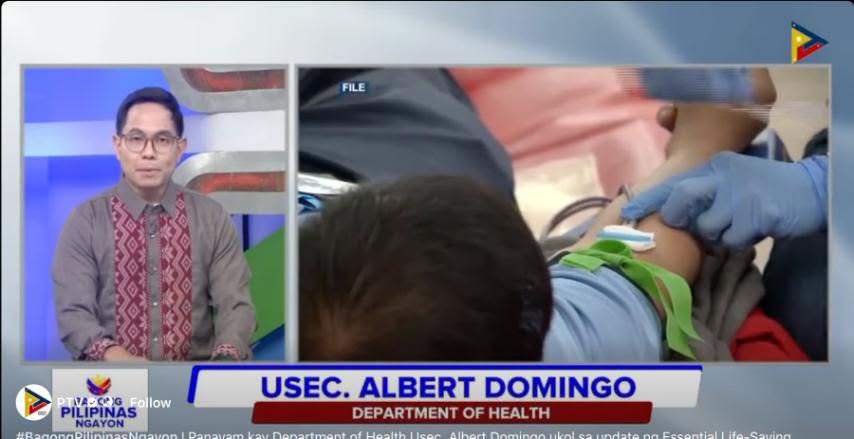
Health Undersecretary Albert Domingo, who heads the DOH’s Essential Life-Saving Services Cluster, said blood supplies typically decline during two periods of the year: the Christmas holidays and Holy Week.
“Sa isang buong taon dalawang bahagi ng taon iyong tinatawag na lean months or iyong medyo bumababa iyong suplay ng dugo: ito po ang panahon ng Pasko ngayong Disyembre; tapos iyong ikalawa, panahon ng ating Mahal na Araw, mga bandang Marso, Abril,” Domingo said during a Bagong Pilipinas interview on Friday.
To address potential shortages, the DOH is strengthening public awareness campaigns and working with communication partners and social media influencers to encourage regular blood donations.
Addressing blood donation misconceptions
Domingo also addressed common misconceptions that discourage potential blood donors from participating in blood collection activities.
He explained that healthy individuals aged 18 and above, or as young as 16 at certain blood centers subject to applicable requirements, who weigh at least 50 kilograms and have no recent illnesses may qualify as donors.
Individuals with tattoos, body piercings, recent surgical procedures, dental extractions, or acupuncture treatments are not necessarily permanently disqualified from donating blood.
“Kung kayo po ay mahigit isang taon na nakalipas sa pag-tattoo ninyo, pwede na ho kayong mag-donate basta one-year po iyong palugit,” he explained.
Domingo added that individuals taking maintenance medications for hypertension or diabetes may also qualify, provided their conditions are adequately controlled and they pass the required medical screening.
Those using injectable glucagon-like peptide-1 (GLP-1) medications for diabetes or obesity were advised to consult their physicians and blood donation centers regarding eligibility and any applicable waiting periods.
He also assured prospective donors that trained doctors, nurses, and medical technologists are available at blood collection sites to assist individuals who may experience dizziness or fainting during donation.
Critical shortage of rehabilitation facilities
Meanwhile, the DOH highlighted a significant gap in the country’s capacity to provide inpatient treatment for individuals with severe drug dependence.
Citing 2023 data from the Dangerous Drugs Board (DDB), Domingo said approximately 1.48 million Filipinos use illegal drugs, with an estimated 15,000 to 74,000 requiring inpatient rehabilitation due to severe substance use disorders.
However, public and private rehabilitation facilities nationwide currently have a combined capacity of only around 7,000 beds, leaving a potential shortage of up to 67,000 beds.
“So, kailangan pa natin ng 67,000 na kama – hindi pa sinasama po iyong mga puwede naman sa community, so, importante ho iyon,” Domingo said.
Beyond expanding inpatient rehabilitation capacity, the health official emphasized the need to strengthen community-based treatment, psychosocial support, and aftercare programs to promote long-term recovery.
Domingo also underscored the importance of strong family relationships, social connections, and community support in addressing substance dependence.
He explained that the brain’s reward system, which involves dopamine, plays a role in addictive behaviors, including substance use and gambling.
The DOH emphasized that addressing addiction requires not only adequate treatment facilities but also comprehensive rehabilitation and sustained support systems that help individuals recover and reintegrate into society.