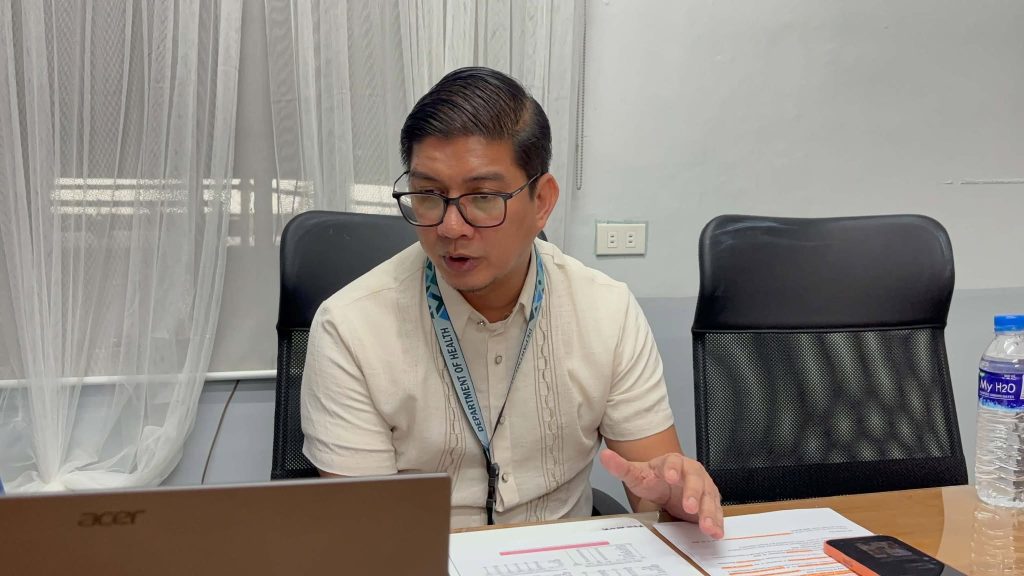

Dr. Van Phillip Baton, officer-in-charge chief of the DOH-7 Local Health Support Division, at a press conference at the DOH-7 regional office on Nov. 23. (PIA7 Cebu)
CEBU CITY, Cebu – The Department of Health in Central Visayas (DOH-7) intensified its dengue surveillance, community cleanup campaigns, and coordination with local government units (LGUs) as the region recorded 21,357 cases and 119 deaths from January 4 to November 14, 2026.
Dr. Van Phillip Baton, officer-in-charge chief of the DOH-7 Local Health Support Division, said during a press conference on November 23 that epidemiological surveillance officers had been deployed to highly urbanized cities, component cities, and municipalities across Cebu and Bohol.
Development management officers were also assigned to local health boards to provide technical assistance to LGUs.
The regional health office has been coordinating with hospitals to monitor bed capacity and working with the Department of the Interior and Local Government (DILG) and other agencies to encourage early intervention.
“If we can control it, control it as soon as possible,” Baton said.
Strengthening community-based prevention
DOH-7 urged local governments to strengthen coordination with barangays, emphasizing the importance of household-level surveillance in preventing the spread of dengue.
Barangay health workers were directed to conduct fever surveillance and immediately report clustering of cases to local health authorities.
The agency also reminded residents to observe the “4 o’clock habit” under the nationwide Alas Kwatro Kontra Mosquito campaign, which encourages households, schools, and workplaces to eliminate potential mosquito breeding sites daily at 4 p.m.
Barangay officials were likewise urged to conduct cleanup operations in cemeteries, junkyards, and other areas where stagnant water may accumulate.
DOH-7 stressed that misting alone was insufficient to control dengue transmission and should be complemented by cleanup activities targeting mosquito breeding grounds.
Residents experiencing fever were advised to seek immediate medical consultation instead of self-medicating, particularly as dengue and influenza symptoms may overlap.
Baton said early detection could allow many dengue patients to recover at home under medical monitoring, while those requiring hospitalization would be accommodated.
The agency continued to provide technical assistance and essential supplies, including NS1 dengue test kits, misting chemicals, and treated mosquito nets. However, LGUs were encouraged to procure additional supplies as commodity support had declined compared with previous years.
Outbreak concerns amid El Niño
Bohol declared a province-wide dengue outbreak in August through Executive Order No. 40, series of 2026.
Baton explained that outbreak declarations remained within the authority of local governments and could help mobilize additional funding and medical resources.
He said DOH-7 provided technical guidance but did not impose a fixed case threshold for declaring an outbreak, as the decision depended on the capacity of local healthcare systems to manage infections.
“No local government unit in Cebu province or the highly urbanized cities has informed DOH-7 of plans to declare an outbreak,” Baton said.
Health authorities also raised concerns over the impact of El Niño, which the Philippine Atmospheric, Geophysical and Astronomical Services Administration (PAGASA) classified as very strong on November 4.
DOH-7 warned that higher temperatures could accelerate mosquito development, while increased household water storage could create additional breeding sites.
Central Visayas dengue cases reach over 21,000
From January 4 to November 14, Cebu province recorded the highest number of dengue infections at 7,816, followed by Bohol with 5,623, Cebu City with 4,732, Lapu-Lapu City with 1,968, and Mandaue City with 1,218.
Bohol registered the highest number of fatalities at 42, followed by Cebu province with 40, Cebu City with 22, Lapu-Lapu City with eight, and Mandaue City with seven.
In Cebu province, Talisay City recorded 916 infections and seven deaths, followed by Toledo City with 847 cases and two deaths, and Minglanilla with 534 cases and two deaths.
In Bohol, Tagbilaran City registered 610 cases and five deaths, followed by Talibon with 407 cases and five deaths, and Inabanga with 405 cases and one death.
Children aged six to 10 accounted for the largest share of infections at approximately 25 percent, followed by individuals aged 21 and above at 24 percent and children aged one to five at 21 percent.
Those aged 11 to 15 accounted for 17 percent, while individuals aged 16 to 20 represented 12 percent and infants below one year old accounted for approximately two percent.
The average age of dengue patients was around 11 years old.
Baton also warned that the simultaneous increase in influenza-like illnesses, which began in the second half of the year, was placing additional pressure on hospital bed capacity across the region.