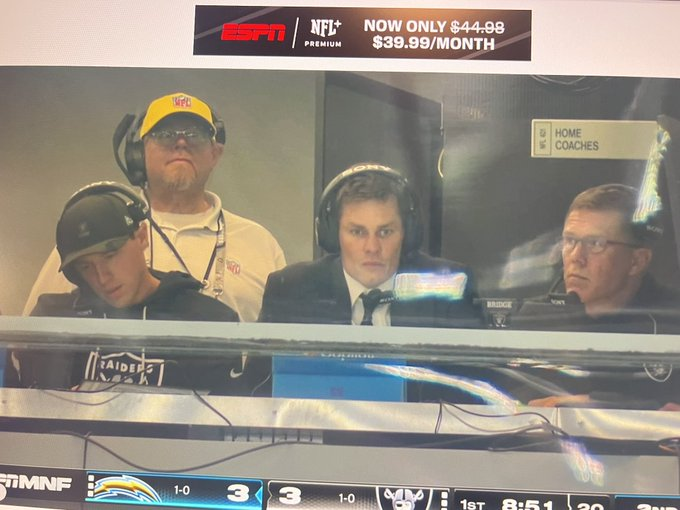

Tom Brady’s presence is once again stirring debate in the NFL — this time not because of anything he’s done on the field, but for where he’s sitting off it. Just days after calling a prime-time game for Fox, the seven-time Super Bowl champion was spotted inside the Las Vegas Raiders’ coaching booth, wearing a headset and observing sideline communications.
For many, the optics were jarring: Brady is both a lead analyst for Fox Sports and a limited owner of the Raiders. This season, he’s slated to call games featuring six Raiders opponents, including two against division rival Kansas City. The question swirling around league circles is whether Brady’s dual roles risk tipping the NFL’s competitive scales — or if the fuss is simply overblown.
The tightrope he walks
Brady’s situation is unprecedented. The NFL has allowed former players to transition to broadcasting or front office roles, but never before has a team owner also served as a network’s top game analyst.
League spokesman Brian McCarthy clarified that Brady, as a limited partner, is allowed to sit in the booth and wear a headset as long as he abides by equipment rules. Yet, league policy also limits his access: he cannot attend practices or production meetings at team facilities, and may only join broadcast prep meetings virtually and away from club premises.
Fox has deflected questions about conflicts of interest, while the NFL has framed Brady’s access as consistent with policy. Still, the sight of him monitoring in-game communications — especially of teams he’ll soon be analyzing on national TV — has raised eyebrows across the league.
Whispered worries from inside the league
Yahoo Sports spoke with nine current coaches and executives. Their views revealed a league divided.
Five said Brady’s role creates a legitimate competitive concern. They argued that broadcast production meetings often feature strategic discussions, and Brady’s Raiders ties might make teams less candid with him.
Others downplayed the risk, noting that coaches rarely reveal sensitive details to broadcasters anyway. One NFC assistant said, “There’s nothing we say in those meetings that would change the outcome of a game.”
Yet some concerns stemmed from reports — later softened by Raiders head coach Pete Carroll — that offensive consultant Chip Kelly speaks with Brady several times a week about game plans. Even if Brady is not directly coaching, executives worry that informal football chats could blur lines between ownership and analysis. As one AFC executive put it, “We’re trusting him to separate what he hears as a broadcaster from what he might share as an owner.”
More about perception than reality
The debate highlights an awkward reality: the conflict may be less about competitive substance than public perception. Even if Brady gains no actionable advantage, his dual roles invite suspicion.
Two executives said Brady’s mere presence in the booth “looks bad,” even if it yields no real edge. Another said, “If he’s offering live input during a Raiders game, the damage would already be done — from everything he saw and heard earlier in the week.”
The NFL has thrived on public trust in its competitive integrity, and perception can erode that. League owners could revisit Brady’s boundaries when they meet in October, just as they approved his ownership stake last year.
The league may still choose the star power
Ultimately, the NFL appears willing to tolerate some discomfort to keep Brady involved. He remains one of the sport’s biggest names, and his presence draws viewers — a valuable commodity as the league leans on its $111-billion media deals.
Whether Brady’s balancing act ever crosses the line from awkward to unfair remains to be seen. For now, the NFL seems to have decided that the upside of its most famous quarterback’s continued spotlight outweighs the risk of controversy he brings along with it.