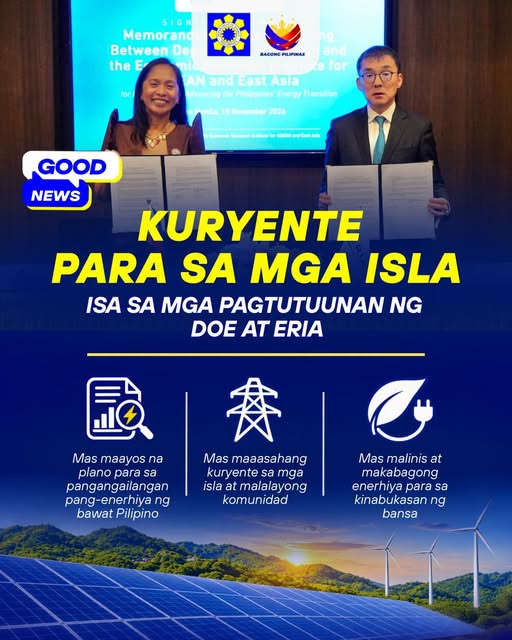

MANILA, Philippines — The Department of Energy (DOE) is strengthening its partnership with the Economic Research Institute for ASEAN and East Asia (ERIA) to develop policies and energy solutions aimed at providing reliable, affordable, and cleaner electricity, particularly in island communities heavily dependent on diesel-powered generation.
Under a two-year Memorandum of Understanding (MOU), the DOE and ERIA will collaborate on research, technical assistance, and energy planning to address the country’s growing electricity demand while supporting long-term energy security.
A key component of the agreement is the study of small-scale liquefied natural gas (LNG) systems and other energy technologies that could help reduce the dependence of island communities on diesel fuel.
The initiative seeks to identify alternative power generation solutions suited to the unique geographical and energy requirements of the Philippines, where remote islands often face challenges in accessing stable and affordable electricity.
The partnership will also explore opportunities to strengthen power grid connectivity across the Association of Southeast Asian Nations (ASEAN), supporting broader regional efforts to improve energy integration and cooperation.
Through joint research and technical support, the DOE and ERIA aim to develop evidence-based recommendations that could guide future energy policies, infrastructure investments, and technology deployment.
The collaboration forms part of the DOE’s continuing efforts to diversify the country’s energy sources, improve electricity reliability, and promote cleaner energy technologies while ensuring that energy development remains responsive to the needs of Filipino households and businesses.
The two-year agreement is expected to support the government’s long-term energy planning, particularly in identifying practical solutions for underserved and geographically isolated communities.
The DOE emphasized that strengthening international research partnerships is essential to developing an energy system capable of meeting rising demand while balancing affordability, reliability, and environmental sustainability.