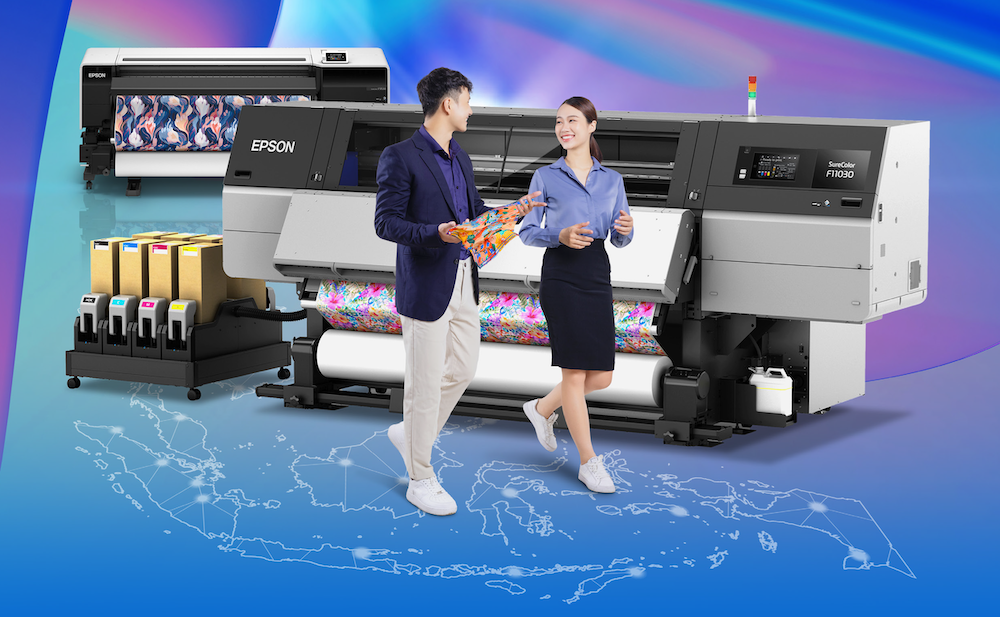

Digital dye-sublimation printing is rapidly reshaping Southeast Asia’s textile print industry, delivering faster growth, broader market opportunities, and measurable sustainability gains, according to a new whitepaper released by Epson in collaboration with International Data Corporation.
The study, titled Digital Textile Printing Trends in Southeast Asia, draws on a regional survey of textile print providers and decision-makers in the Philippines, Indonesia, and Thailand, highlighting how businesses are turning to digital solutions as customer demands evolve and competitive pressures intensify.
The report finds that appetite for customised, high-quality, and sustainable textile products is accelerating adoption of digital dye-sublimation across the region. Shipments of digital dye-sublimation printers in Asia Pacific have doubled from fewer than 1,500 units in 2017 to more than 3,000 units expected by the end of 2025.
For print providers, this surge reflects growing demand for durability, vibrant colour output, and faster turnaround times—areas where traditional screen printing increasingly falls short. Nearly half of respondents cited cost-effectiveness for small runs and customisation as a key driver for adoption, noting that dye-sublimation allows multi-design, high-quality output even at single-item volumes.
The economic impact is striking. Companies that have invested in digital dye-sublimation are recording revenue growth eight times faster than those relying solely on legacy screen printing, with average growth of 8.4 percent over 24 months compared with just over 1 percent for traditional methods.
By enabling short-run and on-demand production, dye-sublimation removes the need for large minimum orders and opens new revenue streams, from fabric rolls to niche applications such as textile labels and tags. This flexibility has allowed 60 percent of surveyed providers to expand into new customer segments, including event organisers, brand owners, and independent fabric designers.
Changing lifestyles across Southeast Asia are also shaping demand. The rise of outdoor activities such as marathons and hiking has fuelled growth in customised apparel, particularly in polyester-based sportswear well suited to dye-sublimation. More than four in five providers now serve the apparel and sportswear market, while opportunities are also emerging in homeware and footwear.
Over half of respondents reported improved customer experience as a direct result of faster production cycles and the ability to deliver complex, personalised designs—capabilities that are difficult to achieve with conventional screen printing.
Sustainability has emerged as a strategic priority alongside growth. As Southeast Asia strengthens its role as a global textile hub, many print providers view digital dye-sublimation as a pathway to reduce environmental impact while improving operations. Seven in ten respondents said sustainability is important to their business even when customers do not explicitly demand it, a figure that rises to nearly nine in ten among companies using dye-sublimation exclusively.
At the same time, only a third believe their customers place the same level of importance on sustainability, pointing to a communication gap across the value chain.
Beyond environmental considerations, the report highlights tangible operational benefits. Compared with traditional screen printing, which consumes large volumes of water and chemical inks and generates significant waste, digital dye-sublimation offers a cleaner, more efficient process. One-third of users also reported improvements in workplace health and safety, citing reduced direct contact with chemical inks and lower exposure to harmful emissions.
For industry leaders, these findings position dye-sublimation as more than a printing upgrade. “While there is clear industry momentum towards sustainable printing, the research highlights a gap between provider ambition and customer priorities,” said Masako Kusama, president and director of Epson Philippines Corporation. She noted that this gap presents an opportunity for technology providers and industry partners to better articulate the business, environmental, and health advantages of sustainable printing practices.
According to Epson, digital dye-sublimation combines eco-conscious production with lower energy use, reduced waste, safer working conditions, and access to higher-value markets. By integrating advanced, energy-efficient technologies, the company aims to help Southeast Asia’s textile print sector compete globally while moving toward a more sustainable future.
The full whitepaper, Digital Textile Printing Trends in Southeast Asia, is available for download from Epson Southeast Asia.