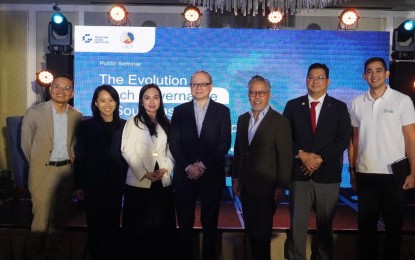

Department of Information and Communications Technology (DICT) and Tech for Good Institute (TFGI) officials pose for a photo with other guests after discussing the evolution of tech governance in Southeast Asia during a seminar in Makati City on Thursday (July 24, 2025). They are (from left) TFGI program manager Keith Detros, DICT Assistant Secretary Celine Dee, TFGI program director Citra Nasruddin, TFGI advisor Anton Periquet, LaunchGarage managing director Jay Fajardo, InnovationPH chair Anton Mauricio, and Grab Philippines head of Public Affairs Strategy Gio Tingson. (Photo courtesy of DICT)
The Department of Information and Communications Technology (DICT) is setting its sights high—targeting the creation of over eight million digital jobs by 2028 under its newly launched “Trabahong Digital” policy roadmap.
Unveiled during a public seminar in Makati on Thursday, the initiative marks a nationwide call to action aimed at empowering Filipinos to seize opportunities in the ever-expanding digital economy.
“This is about giving every Filipino the tools and access they need to thrive in a digital world,” the DICT said in a statement. The roadmap outlines four key pillars: expanding digital infrastructure, developing future-ready talent, supporting local innovation, and crafting inclusive, adaptive regulations.
DICT Assistant Secretary Celine Dee emphasized the human potential driving this transformation.
“The Philippines’ digital progress is fueled by the resilience and creativity of our people,” she said. “With the right systems in place, Filipino ingenuity can spark widespread economic growth.”
The event was held in partnership with the Tech for Good Institute (TFGI), a regional think tank promoting responsible digital development. TFGI program director Citra Nasruddin echoed the need for balance between innovation and inclusion.
“It’s not just about growing the digital economy, it’s about protecting the digital society,” she said. “Our collaboration with DICT reflects a shared vision where people remain at the heart of progress.”
The seminar also coincided with the release of TFGI’s 2024 report, “The Evolution of Tech Governance in Southeast Asia-6,” which explores how governments across the region can foster sustainable, inclusive, tech-driven growth.
TFGI program lead Keith Detros underscored the importance of tailoring global strategies to local realities.
“Tech governance should empower, not exclude,” he noted. “While we can learn from global models, it’s essential to shape policies that reflect the unique context of the Philippines.”
With the “Trabahong Digital” roadmap, the DICT is not just pushing for job creation—it’s laying the foundation for a resilient, inclusive, and future-proof digital Philippines.