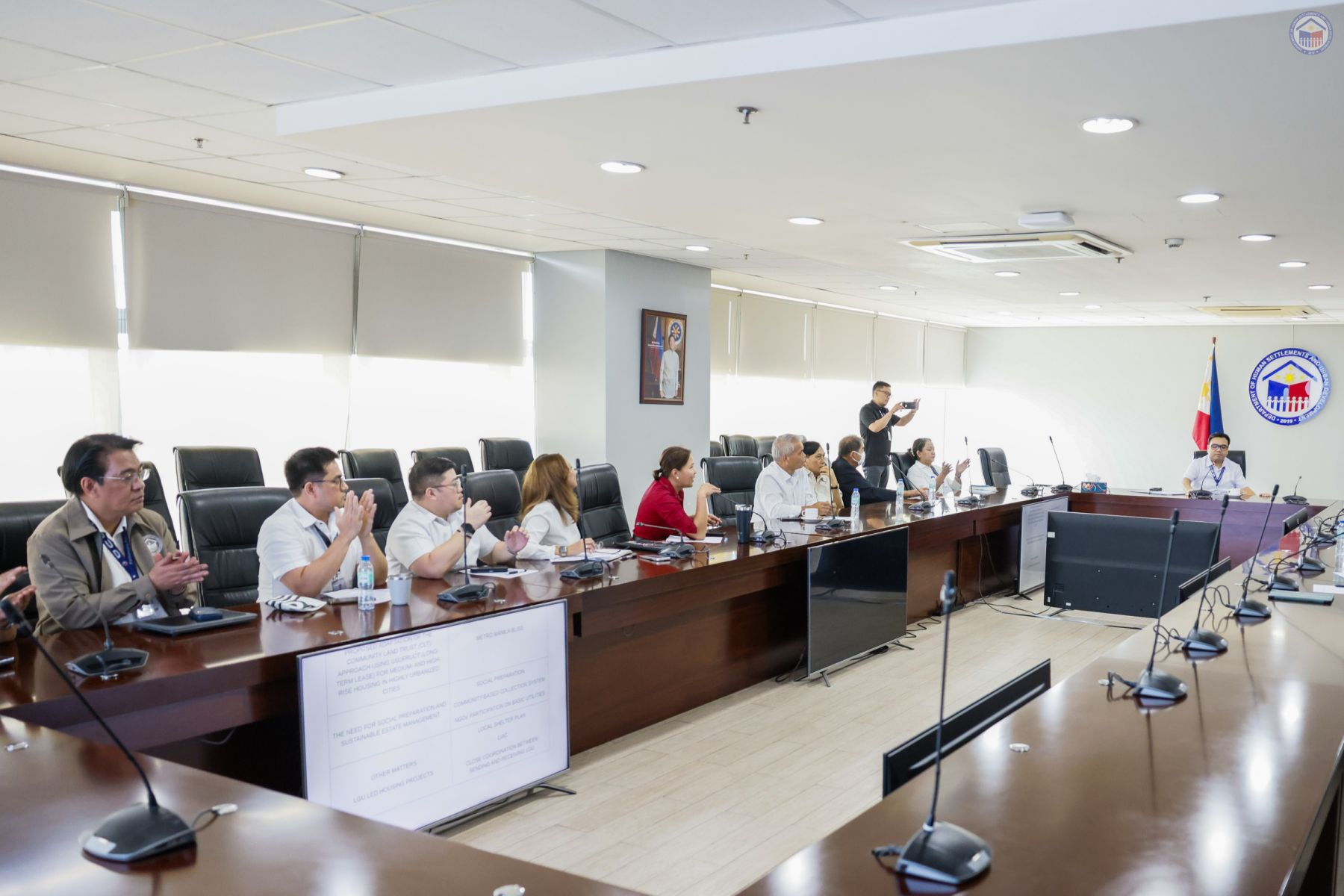

In line with President Ferdinand R. Marcos Jr.’s directive to implement people-centered policies, the Department of Human Settlements and Urban Development (DHSUD) has begun engaging a broad range of stakeholders—particularly non-government organizations (NGOs)—to ensure greater public participation and inclusivity in its flagship housing initiative.
On Monday, DHSUD secretary Jose Ramon P. Aliling hosted a dialogue with several housing experts and NGO leaders to discuss expanded approaches under the Pambansang Pabahay para sa Pilipino Program – Expanded (4PHX). The session brought together urban development veterans including Dr. Nathaniel von Einsiedel, Dr. Mary Racelis, Ana Oliveros of LinkBuild, Dr. Anna Marie Karaos of the JJ Carroll Institute, Vince Eugenio of the Joly Homes Foundation, and Maricel Genzola of the Federation for the Development of the Urban Poor (FDUP).
Central to the discussions was the department’s commitment to evolving the 4PHX program to be more inclusive of vulnerable communities, particularly the urban poor.
“That’s exactly the directive of President Marcos Jr.—to ensure that our housing efforts are inclusive and people-centric, especially for the poorest sectors of our society,” Aliling said. “We’re widening the scope of 4PHX to include different housing modalities—rental units, horizontal developments, and currently under study, incremental housing.”

Participants welcomed the administration’s openness to stakeholder engagement. Several proposed integrating alternative housing strategies into 4PHX such as Community Mortgage Programs (CMP) and High-Density Housing (HDH)—both of which emphasize community participation from planning to implementation.
They also urged DHSUD to consider incorporating “people’s plans” developed by grassroots organizations, especially those representing the urban poor.
Since assuming office on May 26, Secretary Aliling has directed significant reforms to diversify the 4PHX portfolio. Among these is the inclusion of horizontal housing projects, modeled after traditional subdivisions, as well as rental housing, aimed at addressing different affordability levels.
To date, three private developers have pledged over 50,000 units under horizontal 4PHX, while the University of the Philippines-Diliman has expressed willingness to partner on rental housing initiatives.
Aliling has also instructed key shelter agencies to intensify their pro-poor strategies. The Social Housing Finance Corporation (SHFC) has been ordered to revive the Community Mortgage Program, and the National Housing Authority (NHA) is now tasked with developing expanded programs to better serve low-income families.
“As we roll out these new housing modalities, we remain fully open to the ideas of our partners and beneficiaries. Their voices are essential—from the earliest stages of planning all the way to execution,” Aliling emphasized.
Through these efforts, DHSUD is aiming to transform the national housing program into a truly inclusive and participatory initiative that aligns with the President’s vision of a more equitable and people-focused approach to development.