
By Christopher Lloyd T. Caliwan
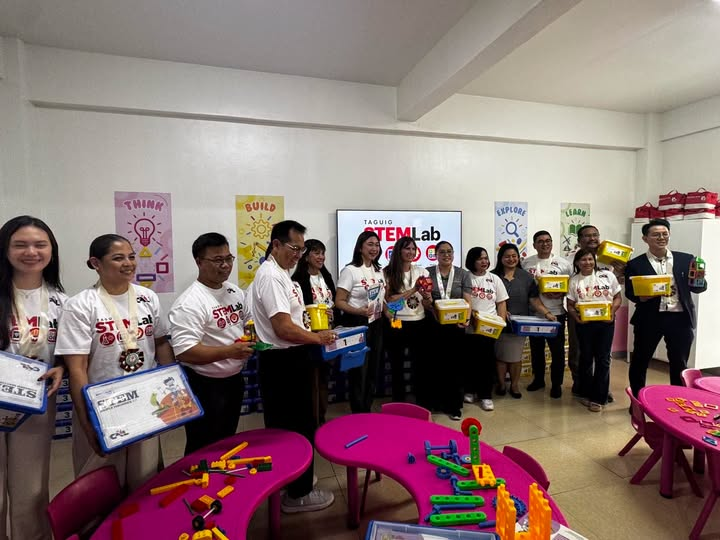
MANILA – The city government of Taguig, in partnership with the Department of Education Division of Taguig and Pateros, on Tuesday launched a program introducing STEM (Science, Technology, Engineering and Mathematics) education to Kindergarten to Grade 3 pupils at Kapitan Eddie T. Reyes Integrated School in Barangay Pinagsama.
The initiative, a first for the division, aims to develop young Filipino innovators by strengthening STEM learning at an early age.
Mayor Lani Cayetano said Taguig is setting a new benchmark in public education as the first local government unit (LGU) in the Philippines to bring an internationally accredited STEM curriculum to all 32 of its public elementary schools, giving young learners access to hands-on experiments, creative exploration and real-world problem-solving.
“The STEM program will be introduced in all public elementary schools in Taguig, all 32 schools. But at the heart of the program is really teacher training. Kahit anong ganda po ng pasilidad at anong gaano kamoderno ang ating mga materials, if we do not have teachers to help us implement the program, hindi po ito magtatagumpay (No matter how beautiful the facility is and how modern our materials are, if we do not have teachers to help us implement the program, it will not be successful),” Cayetano told reporters.
At the center of the program is the Skool21 STEM Series, a Singapore-developed, internationally accredited curriculum already used in schools across more than 10 countries.
Leo Riingen, chair of education services provider CAL Philippines, said the program would give children in Taguig’s public elementary schools access to the same standard of STEM education as their peers in some of the world’s best schools.
“With CAL’s Skool21 STEM Series, even Taguig’s youngest learners will design, experiment and solve real-world problems. When children get to test their own ideas and see what works, they develop the curiosity and confidence they need to become innovators,” Riingen said.
Young learners will explore basic engineering principles, simple machines, levers, gears, and structures, while more advanced topics such as robotics, coding, artificial intelligence, and Python programming are planned for later phases.
The Skool21 curriculum is also aligned with the United Nations Sustainable Development Goals (SDGs), connecting classroom activities to global challenges such as climate change, clean energy, sustainable communities, and technological innovation.
The program will integrate its learning materials with DepEd’s MATATAG Curriculum to complement existing classroom instruction.
MATATAG is a revised basic education program for Kindergarten through Grade 10 (K–10). It stands for makabansa (patriotic), makatao (people-centered), mahusay (competent) and matatag (resilient).
A total of 1,224 Taguig public school teachers completed the training and earned certification as Skool21 STEM educators, equipping them to facilitate experiment-based lessons and guide students in scientific inquiry and problem-solving. (PNA)