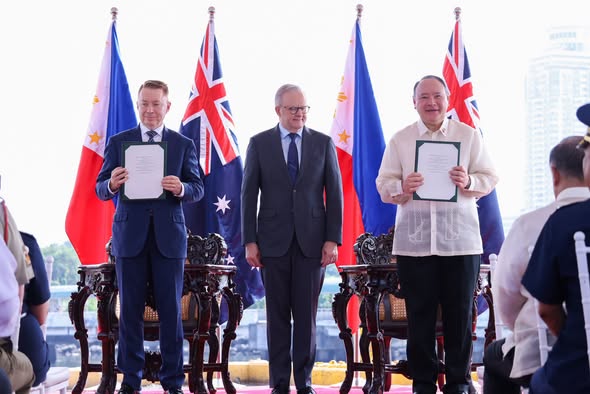
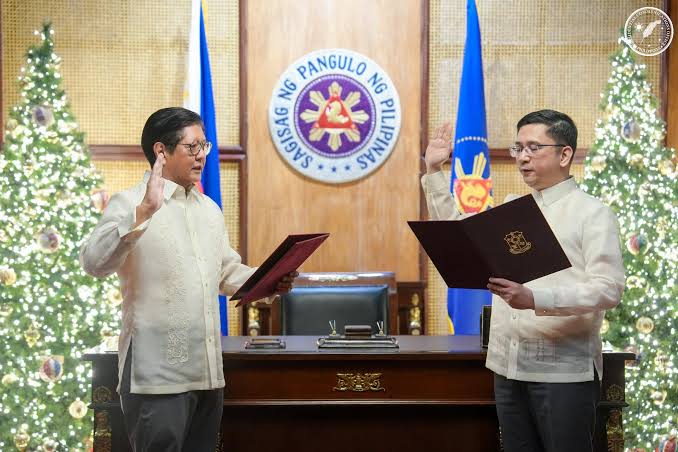
Department of Environment and Natural Resources (DENR) Undersecretary for Policy, Planning and International Affairs Atty. Jonas Leones; DENR Secretary Raphael P.M. Lotilla; SM Supermalls Assistant Vice President for Waste Management and Sustainability Solutions and SM GUUN President George Cheung; SM Investments Corporation Head of Investor Relations and Sustainability Timothy Daniels; SM Retail, Inc. Vice President for Sustainability Suyin Liu; Philippine Alliance for Recycling and Materials Sustainability (PARMS) President Engr. Jess G. Reyes; DENR Assistant Secretary for Environment and concurrent Environmental Management Bureau (EMB) Director Jacqueline A. Caancan.
The Department of Environment and Natural Resources has commended the SM Group for its unified, group-wide approach to plastic recovery and waste management, citing efforts that extend well beyond regulatory compliance.
During a recognition event held on January 30, 2026, the DENR highlighted SM’s implementation of the Extended Producer Responsibility (EPR) Program as a model of coordinated action under Republic Act No. 11898, or the EPR Law of 2022. The agency said SM’s initiatives demonstrate how large, diversified organizations can advance plastic reduction, recovery, and innovation while supporting the country’s Zero Waste to Nature agenda.
“This award reflects the collective effort of the entire SM group,” said Timothy Daniels, head of investor relations and sustainability at SM Investments Corporation. “Across our retail, banking, logistics, and property businesses, we are finding practical ways to reduce plastic use, rethink packaging, and encourage more responsible consumer behavior.”
At the center of SM’s waste strategy is its property arm, SM Prime Holdings, Inc., which leads the #SMWasteFreeFuture campaign. One of its flagship projects is a partnership with Japanese waste processing firm Guun Co., Ltd., which enables waste materials to be converted back into new resources. The collaboration is anchored by the group’s first waste processing facility in Consolacion, Cebu.
Complementing this facility-level solution is the rollout of RDC-labeled bins—recyclable, disposable, and compostable—across SM properties nationwide. Recyclable materials such as paper, bottles, and cans are redirected to recycling plants, while non-recyclable disposables like cups and straws are repurposed as alternative fuel for cement kilns. Food waste is processed into landscaping soil within 48 hours, closing the loop at the property level.
“GUUN shows how waste can remain part of the economic cycle rather than its endpoint,” said George Cheung, president of SM GUUN and assistant vice president for waste management and sustainability solutions at SM Supermalls.
The #SMWasteFreeFuture platform consolidates multiple waste reduction and recovery initiatives across SM’s businesses into a single, cohesive system, reinforcing the group’s long-term commitment to environmental responsibility and community sustainability.
Public participation remains a key component of this effort. SM Supermalls continues to run its Trash-to-Cash recycling market, a monthly program in SM malls nationwide where customers can exchange recyclables—including paper, plastics, metals, and even old appliances—for cash. The program facilitates the recovery of more than 1.5 million kilograms of recyclable materials annually. SM malls also host dedicated e-waste bins in Cyberzone areas and deploy plastic waste collection vans in selected locations.
Meanwhile, SM Markets, which covers SM Supermarket, SM Hypermarket, and Savemore, has long promoted reusable shopping through its eco-bag program. In 2025 alone, the sale of 20.8 million Green Bags helped avoid an estimated 31.2 million single-use plastic bags.
“Our response to the plastics challenge is deliberately broad,” Daniels said. “What matters is that these initiatives are practical, commercially viable, and capable of delivering real, measurable impact on one of the country’s most pressing environmental problems.”