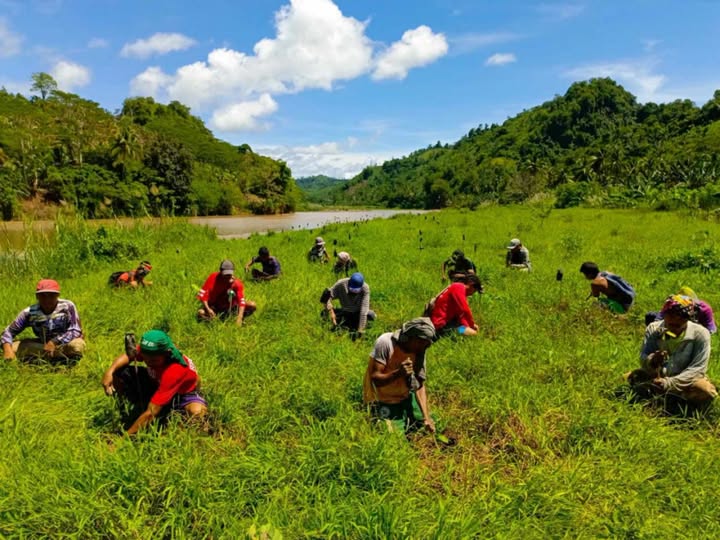

MANILA – To help protect 1,017 Ata-Manobo residents from flooding and possible riverbank collapse, the Department of Environment and Natural Resources (DENR) and the indigenous community have joined hands to restore a 2.1-km. stretch of eroding riverbank in Kapalong, Davao del Norte.
In a news release on Friday, the DENR said the eight-hectare restoration site covers four zones in Sitio Patil, Barangay Gupitan, where strong river currents threatened nearby homes and livelihoods.
“Floods, flash floods, and rain-induced landslides struck the area during 10 recorded major hazard events from 2020 to 2023, exposing the community to recurring risks to homes, livelihoods, and safety,” Environment Secretary Juan Miguel Cuna said.
“Protecting communities from flood risks requires long-term solutions that address the condition of our rivers and the ecosystems around them. In Sitio Patil, restoring riverbank vegetation and working with the Indigenous community are important steps toward reducing erosion and strengthening the natural systems that help protect people and their livelihoods.”
Launched in July 2023 with German development agency Deutsche Gesellschaft für Internationale Zusammenarbeit (GIZ) GmbH, the Ecosystem-based Management and Application of Ecosystem Values in Two River Basins in the Philippines (E2RB) Project uses vegetation to hold the soil together and strengthen the riverbank.
The DENR said the restoration covers eight hectares and uses four plant species: 1,350 hills (clumps) of malibago (Hibiscus tiliaceus), 729 hills of bayog bamboo (Bambusa spinosa), 797 hills of vetiver grass (Chrysopogon zizanioides), and 715 hills of tricanthera (Trichantera gigantea).
This is called a riparian buffer zone rehabilitation where native vegetation is planted along stream banks, rivers, lakes, and wetlands to prevent soil erosion, absorb runoff, and protect water quality.
As the plants grew, their roots helped hold the soil together and make the riverbank less vulnerable to erosion.
Municipal Environment and Natural Resources Office (MENRO) chief John Reycell Tuba said more than 80 percent of the plants have survived, strengthening soil stability, and improving the lives, homes, and livelihoods of the Ata-Manobo Indigenous Cultural Communities (ICC) in the area.
Davao del Norte Provincial Environment and Natural Resources Officer (PENRO) Alberto Bandiola, moreover, said the plants help stabilize the soil naturally while supporting the river ecosystem.
In the early stages of the project, the DENR provided capacity-building activities, including environmental seminars, to increase awareness among IPs and other community members.
As residents were empowered, they began reporting attempts to cut vegetation, as they look after their surroundings.
The DENR said that 30 members of the Indigenous People’s Organization also received training on environmental laws and ecosystem-based adaptation to increase community participation in conservation efforts and help sustain riverbank protection.
Luciano Behaya, chairman of Purok 2A, said residents understood the need to work together to protect the restored riverbank.
“Importante gyud nga magtinabangay mi sa pagtanom ug pag-atiman sa mga tanom sa daplin sa suba. Para ni sa among komunidad, kay makatabang kini sa pagpugong sa pagkahilis sa yuta ug sa pagpanalipod sa among mga panimalay (It is important that we work together to plant and care for the vegetation along the riverbank. This is for our community because it can help prevent soil erosion and protect our homes),” he said.
Participating farmers also received honoraria for planting and maintaining the vegetation.
Patel Farmers Sectoral Farmers Association chairman Nilo Carlos Mungat said the payments help meet members’ needs while allowing them to contribute to environmental protection.
“Dako og tabang sa among asosasyon ang among pag-apil sa proyekto. Ang among nadawat nga honorarium makatabang sa among mga panginahanglan, ug makita namo nga ang among trabaho adunay kapuslanan sa pagpanalipod sa among palibot (Our participation in the project has been a great help to our association. The honorarium we receive helps with our needs, and we can see that our work contributes to protecting our surroundings),” Mungat said.
The restoration is part of efforts to protect a 394.97-hectare landscape of forests, farmlands and floodplains.
The Kapalong municipal government has committed annual funding for watershed protection, water quality management, riparian buffer zone rehabilitation, and tree-growing programs.
It has also established a policy framework for a Payment for Ecosystem Services scheme to support environmental protection.
The DENR said the restored riverbank will need continued monitoring and maintenance.
It said that while the vegetation cannot prevent all floods, its roots can help hold the soil and reduce erosion as the plants mature.
“Dugay na nga kabahin sa among kinabuhi ang suba. Importante nga ampingan ang palibot niini aron mapanalipdan ang yuta ug ang mga pamilya nga nagpuyo duol sa suba (The river has long been part of our lives. It is important to care for its surroundings to help protect the land and the families living near it),” tribal datu Benjamin Sugatan said. (Marita Moaje/PNA)
RIVERBANK RESTORATION. The Department of Environment and Natural Resources (DENR) and the Ata-Manobo community work to restore a 2.1-km. stretch of eroding riverbank in Kapalong, Davao del Norte, to help protect 1,017 residents from possible riverbank collapse, in this undated photo. The DENR said Friday (Oct. 30, 2026) that more than 80 percent of the vegetation planted across the eight-hectare site has survived as residents and farmers continue to take part in its maintenance