
By Mary Judaline Partlow
DUMAGUETE CITY – The Department of Agriculture (DA) in Negros Oriental has begun procuring pesticides to help farmers manage potential crop infestations and diseases expected following El Niño.
Bernard Limbaga, provincial head of the DA-Provincial Agricultural Technology Coordinating Office in Negros Oriental, said Friday that the agency allocated PHP41 million to procure pesticides, seeds and fertilizers for distribution to farmers across the province.
“Aside from this, we are also requesting the DA national office for additional funding for the purchase of solar pump irrigation systems to ensure that farmers have a water supply for their crops,” Limbaga said.
He said the amount of additional funding being sought has yet to be determined, as it will depend on the type of solar-powered irrigation systems to be distributed.
Limbaga noted that rain-fed rice farms are particularly vulnerable to drought because they lack irrigation facilities, unlike farms served by the National Irrigation Administration.
He added that the DA is anticipating an increase in pest infestations, including armyworms, and crop diseases after the El Niño episode ends next year.
According to Limbaga, prolonged dry conditions could cause pest larvae and pupae buried beneath the soil to emerge when rainfall resumes, potentially attacking crops.
Meanwhile, the Provincial Veterinary Office (PVO) of Negros Oriental has drawn up a contingency plan to address El Niño’s effects on livestock and other animals.
Jaymar Vilos, PVO spokesperson, said Friday that veterinary technicians assigned to local government units have already undergone training on response measures. Their local counterparts are also expected to receive similar training soon.
“We have also prepared IEC (information, education, and communication) materials on how to prepare silage, hay and mineral blocks for the animals,” he said.
A mineral block is a compressed supplement containing salt, trace minerals and nutrients that animals lick to help prevent nutritional deficiencies.
Vilos identified heat stress as a major threat to livestock during prolonged dry spells, citing lack of water sources, insufficient forage and animal health concerns as key challenges.
To address water shortages, the PVO has mapped available water sources across the province and positioned water tanks to ensure livestock have supplies.
For animal feed, Vilos said farmers are being encouraged to collect and store corn husks, leaves and stalks during the ongoing harvest season for use as feed for cattle and other livestock.
He also warned that livestock and poultry are vulnerable to heat stress, heat stroke, respiratory diseases such as hemorrhagic septicemia and parasitic infections.
The PVO is urging farmers to closely monitor their animals for signs of illness and immediately contact an agriculture technician or the appropriate government office for assistance.
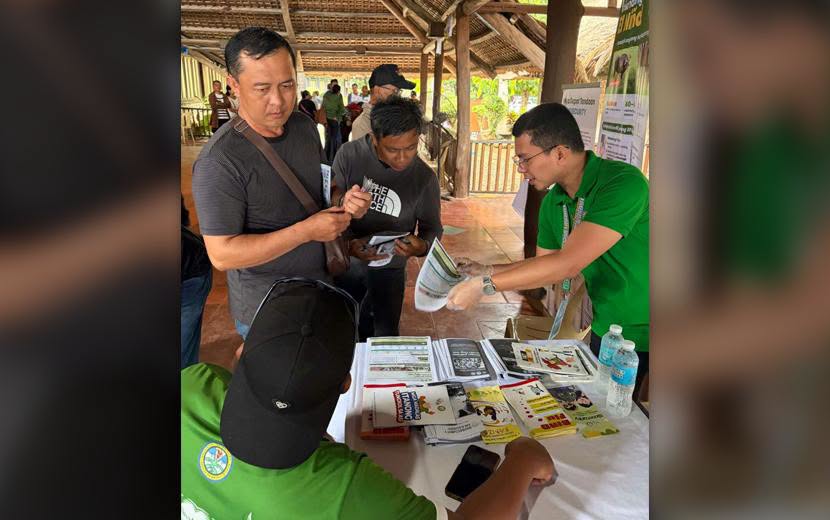
In a related development, the Provincial Disaster Risk Reduction and Management Office held the first of a series of multi-agency information caravans on El Niño on Wednesday.
The activity, held in La Libertad town in the province’s first district, brought together representatives from various government agencies to present their preparedness plans and hear concerns and issues raised by farmers.
Two more information caravans are scheduled this November in Bais City in the second district and Zamboanguita in the third district. (PNA)
INFORMATION CAMPAIGN. Jaymar Vilor (right), spokesperson of the Negros Oriental Provincial Veterinary Office, distributes El Niño-related reading materials in La Libertad, Negros Oriental on Thursday (Nov. 20, 2026). Government agencies are gearing up for the very strong El Niño starting in December. (Photo courtesy of NegOr PVO)