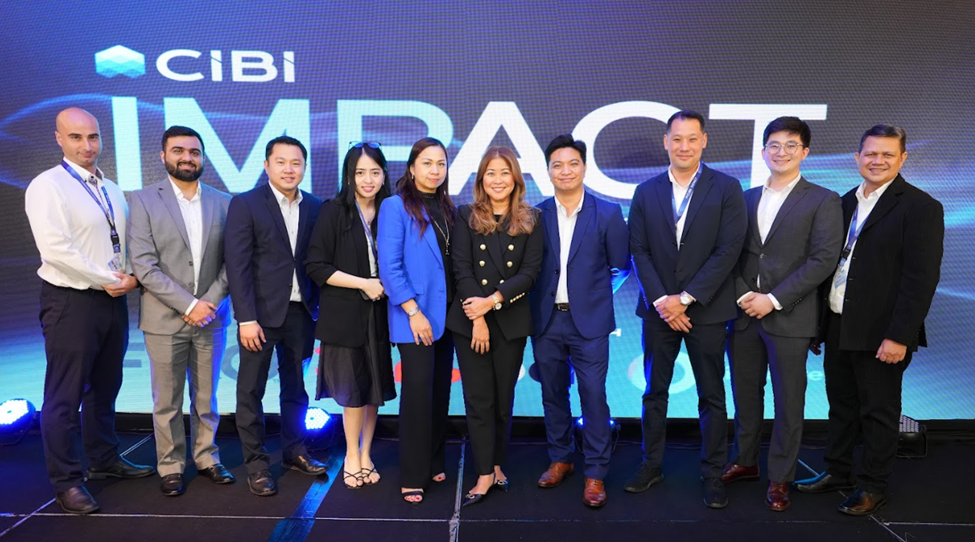

Paulo Ribeiro, head of Sales Planning and Development, CIBI; Shubhranshu Kathuria, vice president, Creador; Harley Chan, chief of analytics, CIBI; Ariana Sandico, head of Strategy and Innovation, CIBI; Ivy Ramirez, vice president for Service and Industrials, CIBI; Pia L. Arellano, president and CEO, CIBI; Miguel Isip, chief financial and corporate services officer, CIBI; Gabby Lopez, head of Business Development and Delivery, CIBI; Rex Rockwell, analyst, creador; and Walter Guilarte, head of Culture, Learning, and Engagement, CIBI.
The Philippines’ credit market is undergoing a pivotal shift. Consumer appetite for financing is surging, yet persistent barriers—limited financial access, insufficient credit data, and high delinquency rates—continue to hinder growth. At the heart of the challenge is trust: in data, in institutions, and in the system itself.
This tension framed the discussions at CIBI Impact 2025, the first-ever industry summit organized by CIBI Information, Inc., the country’s only local credit bureau. More than 150 regulators, senior executives, and decision-makers gathered to assess the industry’s current realities and chart a future rooted in transparency, collaboration, and innovation. The collective call was clear: the future of Philippine credit depends on trusted data and cross-sector partnerships to fuel inclusion and sustainable growth.
Credit demand rising, driven by new behaviors
At the summit, experts underscored how Filipinos are embracing credit at unprecedented levels. Metrobank Chief Economist Nicholas Mapa pointed to strong demand, while CIBI Chief Analytics Officer Harley Chan highlighted the rapid rise of tradelines. Notably, Buy Now, Pay Later (BNPL) products are expanding faster than traditional mortgages, auto loans, and credit cards—propelled by fintech adoption, stronger government support, and improved compliance in reporting to the Credit Information Corporation (CIC).
Consumer awareness of credit data is also gaining traction. CIC President and CEO Atty. Ben Baltazar revealed that by mid-2025, Filipinos had accessed more than 10 million credit reports—a figure expected to climb as lending grows.
The trust gap: Still the weakest link
Despite momentum, deep gaps remain. JurisTech CEO See Wai Hun noted that nearly half of Filipinos remain unbanked, with only 1% of loan applications accepted due to incomplete or inadequate credit histories. Meanwhile, high delinquency rates and billions lost annually to fraud erode confidence, forcing institutions to tighten risk assessments and limiting consumer access to much-needed credit.
The lack of reliable, consistent, and transparent data fuels this trust deficit. Fragmented or misleading records slow decision-making, discourage lending, and perpetuate exclusion. The consequence: millions of Filipinos remain underserved, and opportunities for responsible credit growth remain out of reach.
Trusted data: The catalyst for change
CIBI executives stressed that the solution lies not just in more data, but in better data. According to Ivy Ramirez, CIBI Vice President for Service & Industrials, quality information enables companies to make decisions 30% faster, improve efficiency by 25%, and lift profitability by 19%. Transparency, she added, also accelerates revenue cycles by up to 63% and strengthens long-term client relationships.
Conversely, flawed data undermines credibility, fuels poor lending decisions, and increases defaults. Building a trusted data ecosystem, therefore, is not simply an operational upgrade—it is the foundation for financial inclusion and long-term sector stability.
Collaboration as the cornerstone
Another recurring theme at the summit was the need for ecosystem-wide collaboration. Regulators, banks, fintechs, and technology providers must align strategies and share accountability if barriers are to be broken.
Partnerships showcased at CIBI Impact 2025—including those with FICO, JurisTech, and FinScore—demonstrated how coordinated efforts can improve credit visibility, reduce fraud, and expand financial access. The message was clear: systemic challenges cannot be solved in silos.
Building forward with trust
Closing the summit, CIBI President and CEO Pia Arellano reaffirmed the bureau’s commitment to driving inclusion through innovation. She unveiled upcoming initiatives such as the Fraud Bureau and the CIBI Advanced Tier platform, both designed to reinforce compliance, enhance transparency, and rebuild confidence in the system.
While credit demand in the Philippines is accelerating, Arellano cautioned that the trust gap remains the greatest barrier to truly inclusive finance.
“As the world becomes more digital and interconnected, the need for reliable, responsible, and real-time data becomes greater than ever,” she said. “Only by innovating and collaborating can we ensure that trust keeps pace with demand—and build a future where no Filipino is left behind.”
The summit underscored that rising demand is only half the story. Without trust and collaboration, growth will remain uneven. But with shared accountability and a commitment to trusted data, the Philippine credit industry has the potential to turn momentum into meaningful access—unlocking a more inclusive financial future.