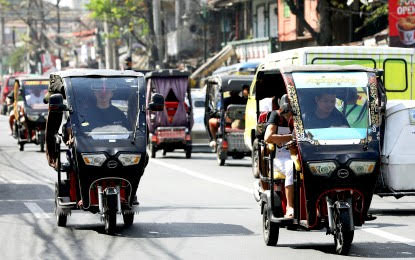

E-trikes ply a major thoroughfare in Metro Manila.
While noting the significant increase in road accidents involving electronic bikes and tricycles, the Land Transportation Office (LTO) that it will soon impound electronic bikes and tricycles (e-bikes, e-trikes) caught operating on major thoroughfares across the country, particularly in highly urbanized areas.
Following this announcement, LTO chief assistant secretary Markus Lacanilao gave his commitment to the Senate that efforts will be made accordingly with regards to the concern even as the proposed budget of the Department of Transportation (DoTr) for 2026 was tackled in the plenary.
“Our new LTO head, Assistant Secretary Lacanilao, has committed that by December 1, all e-trikes on the streets will be apprehended,” senator Joseph Victor ‘JV’ Ejercito, budget sponsor of the DOTr’s budget, noted after conferring with LTO and DoTr officials.
“There you go, e-bikes and e-trikes—starting December 1, refrain from plying your route,” Ejercito added.
For his part, senator Rafael ‘Raffy’ Tulfo cited that unlike the traditional tricycles, e-trike and e-bike operators and drivers are not only unregistered with the LTO but they also do not have a license and insurance—and yet, they are allowed to operate.
Tulfo thus suggested that the LTO and LGUs come up with an agreement to regulate e-bikes and e-trikes, but without “killing” the business of traditional tricycles.
“So, maybe it’s about time we consider requiring these e-bike drivers and operators to get a driver’s license. If not, they should be apprehended, or the LGU should be warned,” the former broadcaster pointed out.
It was at this moment that the LTO vowed to strictly enforce the ban on e-bikes and e-trikes on main streets and thoroughfare, particularly national roads and Highways by impounding those caught violating thus policy beginning this Monday, December 1.
While commending the move, Tulfo advised the transportation agency to conduct an information drive first before apprehending violators.
Tulfo’s advise carried weight to some sectors as Bicol Saro party-list representative Terry Ridon cited that the LTO cannot just impound electric bicycles and tricycles because the agency has no jurisdiction over vehicles that are not registered with it.
Although Ridon, who is also an experienced lawyer, believes the LTO will be using DoTC–LTO Memorandum Circular 89-105 as justification for its assurance to impound e-bikes and e-trikes, but in opposition to this is Republic Act No. 11697, or the Electric Vehicle Industry Development Act, that does not require light electric vehicles (LEVs) to register with the LTO, meaning they are not under the jurisdiction of the LTO or DoTr.
“The Electric Vehicle Industry Development Act (EVIDA Law) clearly provides that LEVs intended for exclusive private use are not required to register with the DoTr and its attached agencies, including the LTO. In other words, the LTO cannot use DoTC–LTO Memorandum Circular 89-105 as the basis for impounding privately used LEVs because these vehicles are not required to be registered with the LTO in the first place. A memorandum circular cannot override a later, specific national law,” the lawmaker explained.
Accordingly, Ridon, who chairs the House of Representatives’ committee on public accounts, disclosed that there is no legal basis to impound LEVs, regardless of whether they are for private use or for hire. But he clarified that he believes LEVs being used as public transportation modes should be registered with the DoTr and local government units before being allowed to operate.
Furthermore, he reminded that there is no legal basis to apprehend and impound LEVs using major national thoroughfares, including national roads identified by the MMDA, because the EVIDA Law itself allows LEVs, whether privately used or for-hire, to use all major local and national roads. .
“To be clear, for-hire LEVs should be registered with the DOTr, its attached agencies, and the local government units (LGUs) in which these LEVs seek to operate. For-hire LEVs should be regulated by the national and local governments in the same manner as other for-hire modes of transportation, such as tricycles. But a clear distinction needs to be made for LEVs used for exclusive private use, which EVIDA expressly exempts from registration,” he expounded.