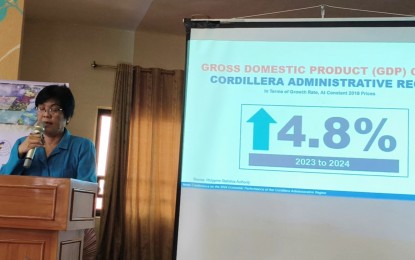
The Cordillera Administrative Region (CAR) recorded a 4.8 percent economic growth in 2024, largely fueled by household final consumption expenditure and a thriving services sector, the Philippine Statistics Authority (PSA-CAR) reported on Tuesday.
In a briefing on the region’s economic performance held at a local hotel, PSA-CAR Director Villafe Alibuyog highlighted that CAR’s gross regional domestic product (GRDP) per capita breached the PHP200,000 mark for the first time, reaching PHP201,088.
Alibuyog said the services sector was the key driver of growth, accounting for 69.4 percent of the regional economy. This was followed by the industry sector at 23.2 percent and agriculture, forestry and fishing at 7.4 percent.
The surge in services was attributed to the tourism industry’s rebound and expansion, particularly with the introduction of new tourism products that diversified visitor experiences and enhanced tourist arrival data collection.
“Tourism has given our economy a much-needed push, and our improved tracking of tourist data also paints a clearer picture of its contribution,” Alibuyog said.
Despite the positive numbers, the 2024 growth rate was slower than the previous year’s 6.9 percent. Still, officials emphasized that the region’s economy remains on an upward trajectory.
“We are still seeing positive momentum,” said Department of Economy, Planning, and Development (DEPDev) Acting Director Jose Dado. “While the pace has moderated, growth in consumption, along with government aid distributed under various programs, has kept household spending strong at PHP144,230 per person annually.”
Dado noted that the agriculture sector, which posted a modest 1.1 percent growth in 2024, showed improvement from a negative performance the year prior. He stressed the need to ramp up agricultural support through modernization.
“Expanding the use of greenhouses, tunnel vents, mechanization, and improved crop varieties will help cushion the impact of climate-related challenges on agricultural output,” he said.
He also underscored the importance of supporting micro, small, and medium enterprises (MSMEs) to compensate for losses in the manufacturing sector and advocated for a shift from mass tourism to more meaningful, experience-focused travel.
For the agriculture sector, the Department of Agriculture in CAR (DA-CAR) expressed optimism about 2025, citing a PHP2.5 billion regular budget plus additional funds from ongoing national and international development projects.
“While the growth is minimal, it shows that our interventions, backed by billions in investment, are making an impact,” said Susan Balanza, DA-CAR Planning, Monitoring, and Evaluation chief. She added that projects such as the Philippine Rural Development Program and the Special Area for Agricultural Development will continue to support the region’s farmers.
Officials are hopeful that with increased diversification, innovation, and investment, CAR can regain and even exceed its previous pace of economic growth in the coming years.