
(Photo courtesy : PIA)
Church officials have announced significant upgrades to the andas, or carriage, that will bear the image of the Black Nazarene during the Traslacion on January 9, 2026, as part of renewed efforts to improve safety, visibility, and crowd flow during one of the country’s largest religious gatherings.
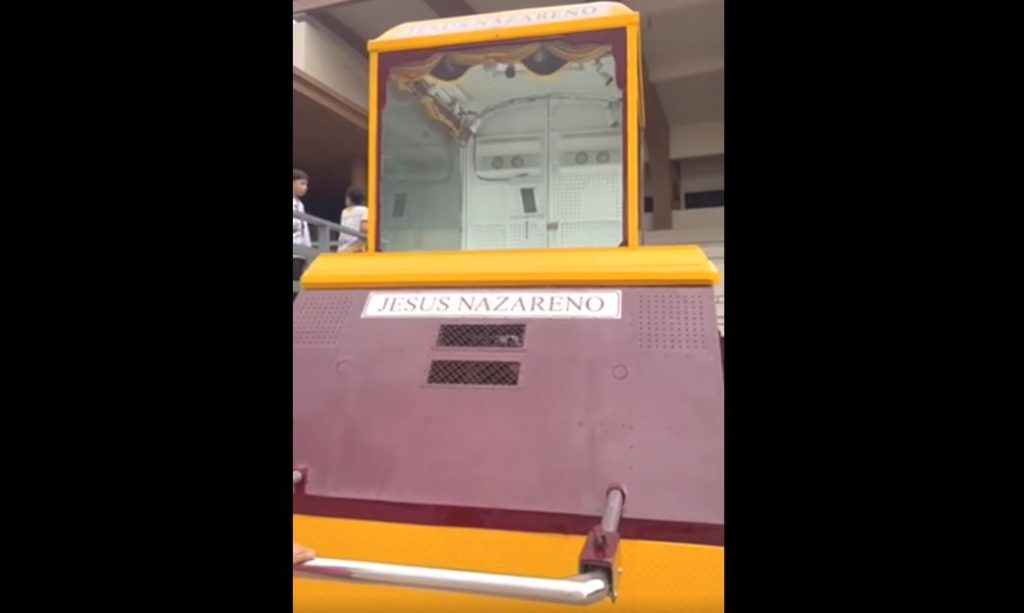
Fr. Robert Arellano, spokesperson for the Minor Basilica and National Shrine of Jesus Nazareno, more commonly known as Quiapo Church, said the new andas is built with stronger stainless-steel components and reinforced wheels to better withstand the demands of the long and densely packed procession.
Among the most notable additions is a sunroof feature, designed to allow natural light to illuminate the image while enabling devotees watching from buildings along the route to clearly see the Jesus Nazareno statue as it passes.
Church organizers also introduced design changes aimed at reducing injuries. The front portion of the andas has been modified with a steeper and more slippery surface to discourage devotees from climbing onto the carriage, a practice that has previously contributed to accidents during the procession.
The annual Traslacion will once again bring millions of devotees onto the streets as the image of Jesus Nazareno is carried from Quirino Grandstand back to Quiapo Church. Organizers are hopeful that the improvements will help ensure a faster and more orderly procession this year.
In 2025, the return of the image to Quiapo Church took nearly 15 hours, with church officials recording a total of 14 hours, 59 minutes, and 10 seconds. Attendance last year reached an estimated 8.1 million devotees, underscoring the scale and logistical challenges of the event.
To support public safety and crowd management, Malacañang has declared January 9 a special non-working day in the City of Manila. Authorities will also implement a gun ban from January 8 to 11 and a liquor ban from January 8 to 10.
Arellano urged devotees to strictly follow established guidelines and security protocols, emphasizing that the measures are meant to protect participants while allowing the faithful to fully observe their devotion during one of the Philippines’ most significant religious traditions.